

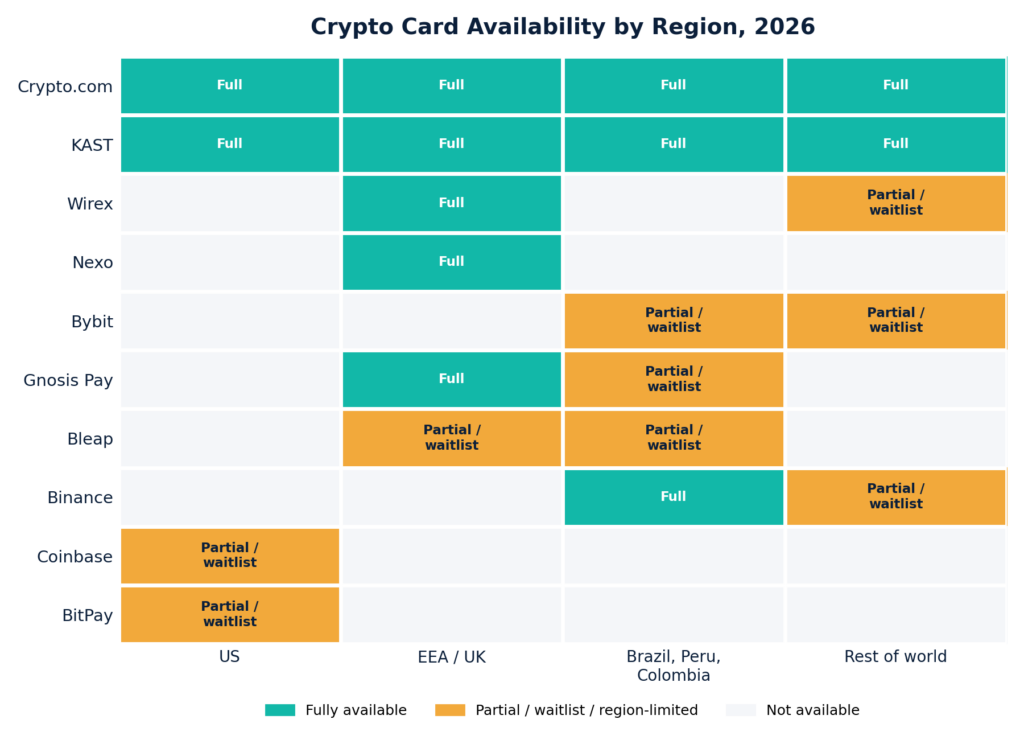
Could you even get the card you’re about to read about? That question eliminates more of this market than any cashback percentage does. Binance’s card is really a Brazilian product with some regional extras bolted on. BitPay has been running a new-applicant waitlist for over two years. Nexo and Gnosis Pay never left the EEA and UK.
This is why the guide for the best crypto cards service operates differently. Geographical preference comes first, since it shortlists everything else from the start. Second, custody matters because it determines who you trust with your funds. Cashback comes last, since what is listed in the ad and what you receive are quite different.
Start with geography
United States
Coinbase Card is open with no credit check and no staking requirement – the waitlist you may have heard about belongs to Coinbase’s newer, Amex-partnered Coinbase One Card, a separate product for people chasing bigger Bitcoin-backed rewards.
Coinbase now sells two cards, and the newer one gets all the noise. The One Card had a waitlist, a steel design and a launch post from the CEO himself:
Spend dollars, get Bitcoin. The Coinbase One Card is fully live in the US! You can apply now to get one. It’s the best looking card with the best rewards, it might make sense to get one in case it catches on. https://t.co/7zCHSzgMr3
— Brian Armstrong (@brian_armstrong) October 22, 2025
That card is credit, it needs a paid subscription, and the top rate depends on how much you hold on Coinbase.
EEA and UK
The most crowded part of the market. Wirex, Nexo, Gnosis Pay, and Bleap all operate here – Bybit’s card, despite what some older reviews still say, currently excludes the EEA entirely, per Bybit’s own program terms. Among the four that do work here: Wirex for 0% FX, Nexo if you want to borrow against crypto instead of selling it, Gnosis Pay or Bleap if you don’t want a company holding your balance at all.
Brazil
The flagship market for Binance’s relaunched Mastercard, which came back in October 2025 as a completely different program from the Visa card Binance shut down globally in 2023. Bybit and OKX both launched Brazil-specific programs around the same time, and Gnosis Pay reaches Brazil through a self-custodial partner app.
The relaunch came from the top. Binance CEO Richard Teng announced it personally, and notice which country he names:
Excited to announce the launch of the Binance Mastercard in Brazil! Upholding our users at the center of our decisions, now millions of users in Latin America’s largest country can seamlessly spend their crypto anywhere Mastercard is accepted. Earlier this year, we had announced the integration of Binance Pay with Pix in the country, allowing 154 million Brazilians to use their crypto to pay in Reais throughout the massive national payment system. This is a big step toward financial freedom and inclusion. Vamos construir juntos, Brazil! Read more 👉 https://t.co/FFIRopr10H
— Richard Teng (@_RichardTeng) October 1, 2025
Everywhere else
Crypto.com and KAST are the two names that show up almost regardless of where you’re reading this – KAST alone claims 170+ countries. Neither needs the kind of local banking license that Nexo, Bybit, or Binance’s card depends on.
Who’s actually holding your money
Between the moment you load a card and the moment you tap it, whose systems is your balance sitting in? For eight of the ten cards here – Crypto.com, Coinbase, Wirex, Nexo, Bybit, Binance, BitPay, KAST – the response is the company’s. That’s normal; most financial products work this way, and it’s part of why these cards can offer richer rewards and easier sign-up than the alternative.
Despite being two very distinct kinds of cards, both have their downsides as well. Gnosis Pay uses a Visa card and connects it to a smart-contract wallet that can be described as a secure wallet where the user’s money is verified using blockchain technology, not through any company ledger. An attempt was made to test it in 2025 by attacking one part of the smart contract.
Self-custody is another factor worth considering when choosing a crypto card. For some users, keeping control of their funds until a payment is made matters more than earning the highest possible cashback.
In a September 2026 Reddit discussion about self-custodial stablecoin cards, one participant summed up the trade-off:
“I would take lower rewards if the tradeoff is keeping custody of the funds until I actually spend them”
That preference helps explain the appeal of cards such as Gnosis Pay and Bleap, although self-custody also means taking greater responsibility for wallet security.
The fee that quietly costs more: FX

Marketing budgets are allocated to cashback; FX markup hurts a frequent traveler’s balance more. Wirex and Bleap don’t add any extra cost on foreign transactions. Nexo is positioned somewhere in between – an FX fee of about 0.2% when trading inside the EEA/UK region and higher fees if you use Nexo’s services outside of the EEA/UK, together with a weekend charge – thus, not being that “0% card” described in older reviews.
For everyday spending, cashback is only part of the equation. Conversion spreads and foreign transaction fees can reduce the value of rewards, particularly for users who make frequent purchases in different currencies.
One Reddit user raised this exact concern when comparing crypto cards with traditional debit cards:
“The conversion fees thing is just money you’re throwing away every single time you spend”
The discussion highlights why it is worth comparing the total cost of spending, rather than choosing a card based on its advertised cashback rate alone.
The ten cards
1. Crypto.com Visa Card

Crypto.com Visa Card is mainly aimed at people who already use the Crypto.com ecosystem. The card itself is fairly straightforward, but its value depends heavily on how much you use the wider platform and whether the extra rewards warrant the conditions attached to higher tiers.
Pros:
- Suitable if you currently store money and manage spending via Crypto.com.
- Higher tiers offer additional ecosystem benefits beyond card bonuses.
- The card can work well for regular everyday spending rather than occasional crypto purchases.
- The prepaid structure holds it separate from traditional credit products.
Cons:
- The reward structure is more complicated than a simple flat-rate cashback card.
- Some purchases are excluded from the rewards program.
- The value of higher tiers depends on how much you actually spend.
- Users who do not need the Crypto.com ecosystem may find simpler alternatives elsewhere.
A crypto card can be convenient if you already hold stablecoins, but the real test is how smoothly the full payment process works. Users still need to consider conversion costs, refunds and whether they can withdraw their remaining balance without unnecessary steps.
In a Reddit discussion about paying with crypto in 2026, one user explained why withdrawal flexibility matters:
“being unable to withdraw anything is a deal breaker for me.”
The comment highlights a practical detail worth checking before choosing a card: how easily you can access unused funds.
2. Coinbase Card
Coinbase Card is built around simplicity: instead of transferring money to a separate card account, users can spend from their Coinbase balance. This is especially convenient for people who already use Coinbase as their main crypto platform.
Pros:
- Very little setup for existing Coinbase customers.
- Both online and physical card options are available.
- Visa acceptance makes it practical for everyday purchases.
- Rewards can be changed as new offers become available.
Cons:
- Crypto spending can create a taxable disposal in the US.
- Reward offers are not necessarily permanent.
- The card is currently limited to US customers, excluding Hawaii.
- A crypto price spread can still affect the effective cost when you convert cryptocurrency for spending.
3. Wirex Card

Wirex is one of the more established names in crypto payments and is particularly interesting for people who regularly move between currencies. Rather than focusing only on cashback, the product combines crypto, fiat, and card spending in one account.
Wirex has also been simplifying its rewards. In June 2026, it announced that cashback would now be valued in US dollars rather than tied to its own token’s price:
We kept the part people love and rebuilt everything around it. Wirex One cashback brings five clear tiers, rewards valued in USD and full-tier earning on every eligible transaction. The system is simpler, and the value is easier to see. Which change excites you most? https://t.co/RxjAi4ed6y
— Wirex (@wirexapp) June 13, 2026
A welcome change, though the post skipped the actual rates, and the best tiers may still require locking up WXT.
Pros:
- Useful for people who frequently have multiple currencies.
- It has been around for quite some time, so it has more credibility than newer card offerings.
- The app combines spending and crypto management in one place.
- More interesting for travelers than cards focused purely on rewards.
Cons:
- The best value depends on how much you actually use the Wirex ecosystem.
- Premium features can make the card less attractive for occasional users.
- WXT adds another token that users may not otherwise want to hold.
- Country-specific availability can make comparisons with other cards difficult.
4. Nexo Card

Nexo Card is designed less as a simple spending card and more as an extension of Nexo’s broader lending platform. Its main attraction is the ability to use crypto as liquidity without necessarily selling the underlying holdings.
Pros:
- It helps people who have experience borrowing or earning money with Nexo.
- Credit mode provides liquidity while letting you keep crypto exposure.
- Debit mode gives users a more conventional way to spend their holdings.
- The ability to switch modes makes the card more flexible than a standard crypto debit card.
Cons:
- It carries risks not usually associated with a standard debit card.
- Users should understand the collateral rules before using Credit mode.
- Costs can increase when spending outside supported regions.
- It is more complex than a basic card designed only for purchases.
5. Bybit Card

Bybit Card is best viewed as a spending option for people already active on Bybit rather than as a standalone banking product. Its main appeal comes from connecting everyday spending with an existing trading account.
Pros:
- Convenient for users who already trade on Bybit.
- Can make it easier to move from trading activity to everyday spending.
- Higher-tier users can get more value from the rewards structure.
- The card benefits from Bybit’s existing crypto infrastructure.
Cons:
- Region-specific availability makes it hard to treat as a one-size-fits-all program.
- Reward eligibility makes it difficult to compare with standard cards.
- Not very useful if you don’t use Bybit as your primary trading platform.
- Changes to regional programs can affect its long-term usefulness.
6. Binance Card
The current Binance Card is better understood as a regional product than as the return of the old global Binance card. For users in supported markets, the main advantage is convenience: spending is connected directly to an ecosystem they may already use for trading and holding crypto.
Pros:
- Good for people who already use Binance.
- It’s not necessary to transfer money to another cryptocurrency exchange.
- Payments are easy because of the MasterCard system.
- Localized programs can make the card more useful in its main markets.
Cons:
- Old reviews of the discontinued Binance Visa can be very misleading.
- Check availability before relying on the card.
- The product is much less useful outside its supported regions.
- Users looking for a globally consistent card experience may prefer another option.
7. BitPay Card

BitPay Card has plenty of history, but its current status is the main issue. It continues to be relevant for existing customers, but the lack of new applications makes it hard to include among practical choices for someone looking for a card today.
Pros:
- One of the more established names in crypto payments.
- Existing users have a mature payment product.
- Strong focus on spending crypto rather than traditional banking.
- Merchant-specific rewards can occasionally add extra value.
Cons:
- It is not a feasible option for a beginner.
- The application process being on hold makes it less usable.
- Its current position is weaker than newer, actively expanding products.
- Future availability for new customers is still uncertain.
8. Gnosis Pay Card

Gnosis Pay targets users who want a card without giving up control of their funds to a traditional card provider. It connects familiar Visa payments with a Safe wallet, making it one of the more technically distinctive products in this list.
Pros:
- Gives more experienced cryptocurrency users control over their money.
- Its on-chain nature may make transactions easier to validate independently.
- A good match for users already comfortable with Safe and self-custody.
- More transparent from a blockchain perspective than a conventional custodial card.
Cons:
- Self-custody also means more responsibility for the user.
- Wallet and smart-contract issues cannot be handled like a normal bank dispute.
- Less beginner-friendly than a conventional prepaid card.
- The annual wallet cost can make it less attractive for light users.
9. Bleap Card

Bleap is designed to make self-custodial spending feel closer to a normal card experience. It is particularly interesting for users who want to keep control of their funds while still getting straightforward card payments and international spending.
Pros:
- Combines self-custody with a familiar Mastercard experience.
- Multi-chain support gives users more flexibility.
- No need to rely entirely on a traditional custodial balance.
- The product is more appealing to experienced on-chain users than many conventional crypto cards.
Cons:
- Even self-custody requires knowledge of how to secure the wallet.
- The large promotional bonus must not be mistaken for the regular one.
- Geographic coverage is narrower than some custodial competitors.
- It may feel unnecessarily technical for someone who wants a payment card.
10. KAST Card

KAST focuses on stablecoin-based spending and tries to solve one of the biggest problems with crypto cards: availability. Its broad geographic reach renders it especially relevant for users outside the main markets covered by Coinbase, Nexo, or other regional products.
Pros:
- Widespread international presence lets users in marginalized regions use it.
- A stablecoin-based system provides more reliable spending than volatile cryptocurrencies.
- No need to build a staking model for the card.
- The card can be useful for people who work with or own stablecoins.
Cons:
- Season-dependent rewards make it hard to compare cashback over time.
- A broad country list does not mean every feature is identical everywhere.
- Custodial structure may not suit users who prioritize self-custody.
- Users should check the current Season before making cashback a deciding factor.
Numbers still floating around the internet that are no longer true
- “Binance Card pays up to 8% in BNB.” It was the first-ever Visa card in the world, and it ended in December 2023. The current Mastercard is entirely different, coming from Brazil, and offers only single-digit cashback.
- “Coinbase Card has a waitlist.” The standard Coinbase Visa debit card is open. The waitlist belongs to the newer Coinbase One Card.
- “Nexo Card has 0% FX fees.” It doesn’t – expect a small fee inside the EEA/UK and a bigger one outside it, plus a weekend surcharge.
- “Bybit Card works across Europe.” According to Bybit’s current terms, the EEA is not covered by the card and its rewards program.
- “Nexo Card ships a physical card.” New users get virtual card access only since physical card shipments were halted in January 2025.
Quick reference
| Card | Custody | Realistic cashback | Where it actually works | Taking new applicants? |
|---|---|---|---|---|
| Crypto.com Visa | Custodial | Low single digits free tier; higher with staking/subscription | 90+ countries | Yes |
| Coinbase Card | Custodial | 1–4% (asset-dependent) | US (open); EEA growing | Yes |
| Wirex Card | Custodial | 0.5–8% (subscription-tiered) | ~35 countries (EEA/UK/APAC) | Yes |
| Nexo Card | Custodial/Credit | Up to ~2% (Credit mode; none for UK) | EEA, UK & Switzerland | Yes (virtual only) |
| Bybit Card | Custodial | 2–10% (tiered) | Switzerland, Australia, LatAm – not EEA | Yes (region-dependent) |
| Binance Card | Custodial | ~2–3%, capped | Brazil primarily; expanding | Yes |
| BitPay Card | Custodial | No base rate | US only | Paused (waitlist) |
| Gnosis Pay Card | Self-custodial | Up to ~5% (time-limited program) | EEA & UK (+ Brazil via partner) | Yes |
| Bleap Card | Self-custodial | Base rate; up to 20% in categories | EEA, Switzerland; LatAm rolling out | Yes |
| KAST Card | Custodial | Varies by Season — check in-app | 170+ countries | Yes |
Real-world experience can tell you things a cashback table cannot. In a Reddit discussion about crypto cards in 2026, users shared which cards they actually use and what they think of them.
One user summed up their experience with Coinbase:
“Had the Coinbase Debit for a few years now. it’s pretty nice. never had an issue with it.”
Others mentioned using Gnosis Pay daily and noted that rewards and regional availability vary by card.
Conclusion
Start with your country, not your ambitions. That one filter usually leaves you with two or three real options before rewards enter the conversation at all – the rest of the list was never available to you in the first place.
Crypto card usage is also attracting attention beyond individual product launches. In April 2026, investor Constantin Kogan reported that monthly transaction volume on crypto cards had reached approximately $600 million in March, more than three times the level recorded a year earlier.
💳 Monthly transaction volume on crypto cards reached approximately $600,000,000 in March 2026 — more than 3x higher than the same period in 2025. Over the entire lifetime of crypto card usage, users have completed around 22,000,000 transactions, with total transaction volume exceeding $6.6 billion.
— Constantin Kogan (@constkogan) April 9, 2026
The figures suggest growing use of crypto-linked cards, although transaction volume alone does not show how often people use them for routine purchases.
Cash back is purposely saved for last, as it’s the figure every credit card issuer starts with. Still, don’t take it at face value, since most of the time, cash back involves staking, subscriptions, or spending habits that don’t reflect reality.