
Cryptocurrency acceptance is no longer a novelty in 2026, as $8 trillion worth of crypto transactions have been carried out throughout the year, and every month more and more online merchants, software companies, and e-commerce platforms implement the “Pay with crypto” button. There are many different cryptocurrencies in the market of payment gateways that keep your funds until settlement and transfer coins directly to your wallet, taking either a 0.5% commission fee or negotiating on rates.
This review compares the best crypto payment gateway providers of 2026 based on fees, supported cryptocurrencies, custodianship, and fitness to specific business types.
What is a crypto payment gateway?
A cryptocurrency payment gateway provides a solution that lets a business receive payments in cryptocurrencies like Bitcoin, Ethereum, stablecoins, etc., without setting up its own blockchain node, tracking conversion rates, or manually verifying transactions.

Global crypto payment volume has grown from an estimated $2.5T in 2022 to over $8T in 2025.
Unlike card processors, a crypto payment gateway has no chargebacks and no cross-border card fees. It works for any customer with a wallet and an internet connection – which is why it’s become popular with international e-commerce, SaaS, and high-risk verticals that traditional payment processors decline.
Custodial vs. non-custodial gateways
This is the single most important distinction between providers, and it’s often buried in the fine print.
- Custodial gateways (BitPay, CoinGate, NOWPayments, Coinbase Commerce, CoinsPaid) receive customer payments in their own wallets first before settling them to you later – whether it’s in crypto, stablecoin, or fiat. It’s easy to set up, but the downside is that you are taking on the security risks of the provider itself. According to Chainalysis, 2025 was the most disastrous year for hacking attacks in the cryptocurrency world, where more than $3.4 billion was stolen.
- Non-custodial gateways (BTCPay Server and non-custodial modes offered by newer processors) route payments directly from the customer’s wallet to the merchant’s wallet on-chain. There’s no pooled balance to hack and no provider that can freeze funds – but the merchant carries more of the operational burden (running the infrastructure and handling fiat conversion themselves).

Neither model is universally “better” – it depends on how much operational control your business wants versus how much convenience you need.
What to check before choosing a gateway
- Custody model – does the provider hold your funds, even briefly, and what happens if it’s hacked or goes insolvent?
- Licensing and compliance – does the provider have a Money Services Business (MSB) license under the European Union’s MiCA regulatory framework? This is more relevant to merchants targeting the European and US markets.
- Fees – the quoted percentage fee is never the full picture. Conversion spreads, fiat withdrawal fees, one-off set-up fees, and monthly minimums all sit on top of the stated rate.
- Supported coins and chains – do customers actually use the assets you support? A handful of major coins and stablecoins (BTC, ETH, USDT, USDC) cover most real-world demand; hundreds of obscure tokens mostly add clutter.
- Settlement options – do you have the capability to retain the cryptocurrency in its original state, automatically convert it into stablecoins, or settle into your fiat currency account in EUR, USD, or GBP?
- Industry restrictions – most popular gateways (BitPay, Coinbase) prohibit gambling/iGaming and any high-risk verticals; if that is your industry, you will need a specialized processor.
- Integrations – native plugins for WooCommerce, Shopify, Magento, PrestaShop, or WHMCS save weeks of custom development.
The Best Crypto Payment Gateways
BitPay

BitPay, founded in 2011, is the oldest processor still operating and is still a safe, boring-in-a-good-way choice for enterprise procurement teams.
- Supports around 16 cryptocurrencies, including Bitcoin, Ethereum, Litecoin, XRP, Dogecoin, and several stablecoins (USDC, BUSD, GUSD) across Ethereum, Polygon, Arbitrum, Optimism, Base, and Bitcoin Lightning.
- The standard transaction fee is around 1%.
- Merchants can get paid in USD, EUR, GBP, CAD, AUD, and over 30 currencies through SEPA/wire transfer, or keep crypto if they prefer.
- Tiered pricing rewards high-volume merchants.
Pros:
– Oldest player on the market (operating since 2011), which is important for enterprises.
– Reliable daily fiat settlement – good for businesses that don’t want to touch crypto directly.
– Wide range of e-commerce plugins and invoicing tools.
Cons:
– Gambling (iGaming), as well as other high-risk industries, are not allowed.
– Limited choice of currencies, especially when compared to alternative cryptocurrency services.
– Untransparent pricing policy for larger/custom clients (negotiated).
CoinGate

CoinGate is a Lithuania-based gateway founded in 2014 that has positioned itself as the strongest EU-compliant option. It holds both a MiCA license and a Payment Institution (PI) license in the EU, which are increasingly required rather than a bonus for merchants serving European customers.
- Settles in EUR, USD, and GBP, with a flat, published 1% fee.
- Plugins for WooCommerce, PrestaShop, OpenCart, WHMCS, and Wix.
- Also offers payment links and invoicing for merchants who don’t want a full checkout integration.
- Has processed over 7 million payments since 2014.
Pros:
– No sales call; pricing is open and published.
– Very good regulatory stance in Europe (MiCA + PI license).
– Very suitable for small/medium e-commerce businesses to set up quickly.
Cons:
– Custodial model – funds pass through CoinGate’s own wallets before settlement.
– Less suited to industries outside e-commerce/cloud services, or businesses outside Europe.
NOWPayments

NOWPayments is best known for supporting the widest range of assets of any gateway on this list – over 350 cryptocurrencies – with auto-conversion so a customer can pay in one coin while the merchant receives another.
- Transaction fees are 0.5% for same-cryptocurrency transactions and up to 1% in case auto-conversion is enabled.
- Plugins available for Shopify, WooCommerce, Magento, PrestaShop, and WHMCS.
- KYC requirements apply once a merchant crosses certain volume thresholds.
Pros:
– Widest list of coins accepted out there – good if customers use obscure alt-coins.
– Low, transparent flat fee structure.
– Open and clearly documented API.
Cons:
– NowPayments takes custody of funds from transactions for the time of their conversion and settlement. It is a trade-off the platform hardly emphasizes.
– Possibility of complications due to the high number of supported tokens (350+) if they are not properly integrated.
– NOWPayments previously entered an agreement with OFAC regarding some sanctions violations.
Coinbase Commerce

Coinbase Commerce has been rebranded as “Onchain Payments” on the Base blockchain. It offers 1% fixed-rate checkout fees for stablecoin payments and also has native plugins for Shopify, WooCommerce, Magento, and OpenCart.
- USDC, USDT, DAI, or PYUSD as payment options on Base, Ethereum, Polygon, Solana, Arbitrum, or Optimism networks.
- Settlement is custodial through the merchant’s Coinbase account, with an option to auto-convert to USD at spot rate.
Pros:
– The brand recognition and infrastructure from Coinbase behind the payment service.
– Fixed 1% fee, which is simple to understand.
– Good multi-chain stablecoin support.
Cons:
– Very much dependent on the ecosystem provided by Coinbase and its wallets.
– Prohibits gambling across all Coinbase products.
– No direct support for Bitcoin-only customers who don’t hold stablecoins.
BTCPay Server

BTCPay is self-hosted, open-source, and free – you run your own node, point a domain at it, and accept payments with no intermediary at all. It’s the only gateway on this list that’s genuinely non-custodial by design.
- Native support for Bitcoin and Lightning; stablecoin support (USDT, USDC, DAI) is available through community plugins on Ethereum, Liquid, and other chains.
- No KYC, because there’s no third party holding funds – the merchant is the custodian.
Pros:
– Total control: there is no need for processing capacity, frozen balances, and platform.
– Great option for private traders and people living in countries with strict banking laws.
– Open source project that can be audited.
Cons:
– You should have some skills because you will need to keep servers, manage your keys, and route exchanges manually for fiat currency.
– There is no exclusive customer support hotline like with other commercial gateways.
– Stablecoin coverage depends on community plugins rather than first-party support.
Binance Pay

Binance Pay utilizes the user base of Binance exchange to make instant payments without going through an additional registration process.
- Wide asset support and some of the lowest fees in the industry – transactions between users inside the Binance ecosystem can be fee-free.
- Plugins for PrestaShop, WooCommerce, Magento 2, WHMCS, OpenCart, Ecwid, Zen Cart, Shopify, and Shopware.
- Fiat conversion happens only through third-party partners, not natively.
Pros:
– Possibility to reach the huge community of users of Binance who operate cryptocurrencies.
– Low fees, sometimes even industry-low.
– Wide coverage of e-commerce CMS platforms without any additional effort.
Cons:
– Lack of fiat payments functionality – the merchant should have a payment processor.
– Not as well designed as BitPay.
– Less suitable for customers without an account on Binance.
CoinPayments

CoinPayments, one of the longest-running gateways, founded in 2013, has processed more than $50 billion for over 250,000 merchants through hosted invoices, an API, e-commerce plugins, payment buttons, and point-of-sale tools.
Pros:
– Very large number of merchants historically and the transaction amounts that have been reached.
– Several methods for integration (API, plugins, buttons, POS).
– Accepts a lot of different altcoins.
Cons:
– Interface and documentation feel dated compared to newer entrants.
– Custodial model; same considerations as other pooled-wallet gateways apply.
Plisio

Plisio offers the same 0.5% fee as NOWPayments, which is lower than those of most other payment providers. However, it offers limited cryptocurrency support – USDT, USDC, and DAI on Ethereum, Tron, BNB Chain, Polygon, as well as Bitcoin.
Pros:
– One of the lowest fees among all available services (0.5%).
– Nice integration footprint (Shopify, WooCommerce, OpenCart, PrestaShop, as well as invoicing API).
Cons:
– Less widespread stablecoins/chains support compared to more general-purpose payment gateways such as NOWPayments.
– Smaller brand recognition than BitPay or CoinGate.
Triple-A

Triple-A focuses on merchants who want to accept crypto and make crypto payouts without ever directly managing digital assets themselves – everything settles in local currency.
Pros:
– Wide range of licensing coverage via multiple important markets, which is useful from a compliance standpoint.
– Local currency payment predictability without being exposed to crypto pricing fluctuations.
– Highlighted in various third-party industry buyer’s guides as one of the providers of stablecoin cross-border payments.
Cons:
– Not ideal for merchants that wish to keep some crypto or stablecoins in their treasury.
– Integration procedure for compliance settlement is somewhat more complicated than simply adding a checkout button.
CoinsPaid

CoinsPaid is one of the rare processors that serve exclusively high-frequency transactional businesses such as iGaming and forex where other gateways have shied away.
Pros:
– Rare willingness to serve iGaming/forex merchants that BitPay and Coinbase reject outright.
– High-volume processing capability.
Cons:– Custodian processor and has been hacked in the past – a warning to consider the custody risk well here.
– The effective rates after conversion and withdrawal fees can be higher than the stated rate.
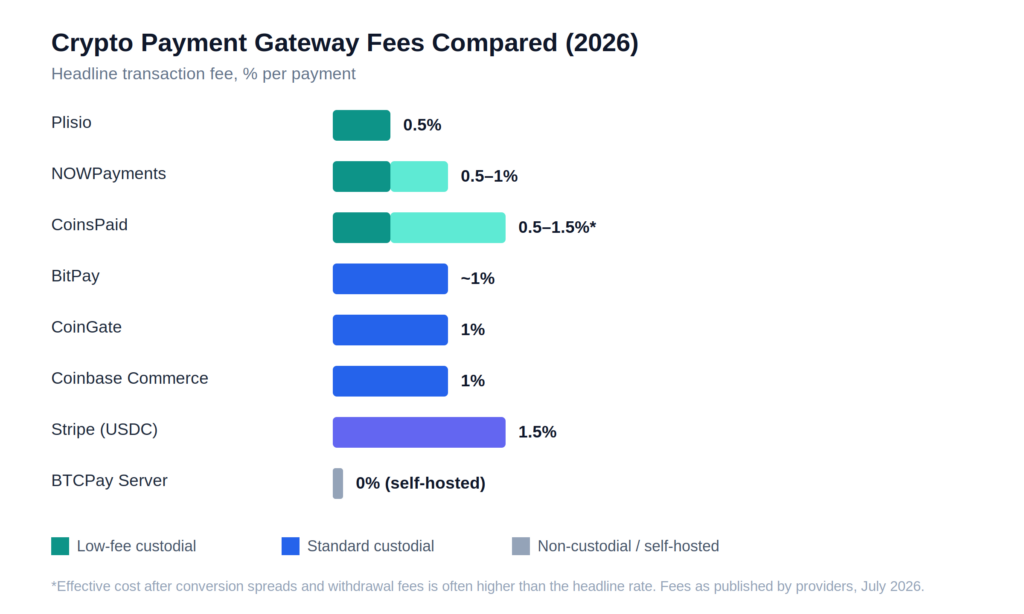
Fees Evaluated
| Gateway | Headline Fee | Custody Model | Fiat Settlement | Notable Coin Coverage |
|---|---|---|---|---|
| BitPay | ~1% | Custodial | USD, EUR, GBP, CAD, AUD+ | ~16 coins, Lightning |
| CoinGate | 1% | Custodial | EUR, USD, GBP | Major coins + stablecoins |
| NOWPayments | 0.5% (1% with auto-convert) | Custodial | Via conversion | 350+ coins |
| Coinbase Commerce | 1% | Custodial | USD (auto-convert) | USDC, USDT, DAI, PYUSD (multi-chain) |
| BTCPay Server | 0% (self-hosted) | Non-custodial | Manual/self-managed | BTC, Lightning, plugin stablecoins |
| Binance Pay | Very low / 0% intra-ecosystem | Custodial | Via 3rd-party partner | Wide asset range |
| CoinPayments | Varies by plan | Custodial | Via conversion | Broad altcoin list |
| Plisio | 0.5% | Custodial | Via conversion | USDT, USDC, DAI, BTC |
| Triple-A | Not publicly listed | Custodial | Local currency | BTC, ETH, stablecoins |
| CoinsPaid | 0.5–1.5% (effective cost higher) | Custodial | Via conversion | Major coins + stablecoins |
Note: fees change frequently and often depend on volume tier – always confirm current pricing directly on the provider’s site before integrating.
Which gateway fits which business?
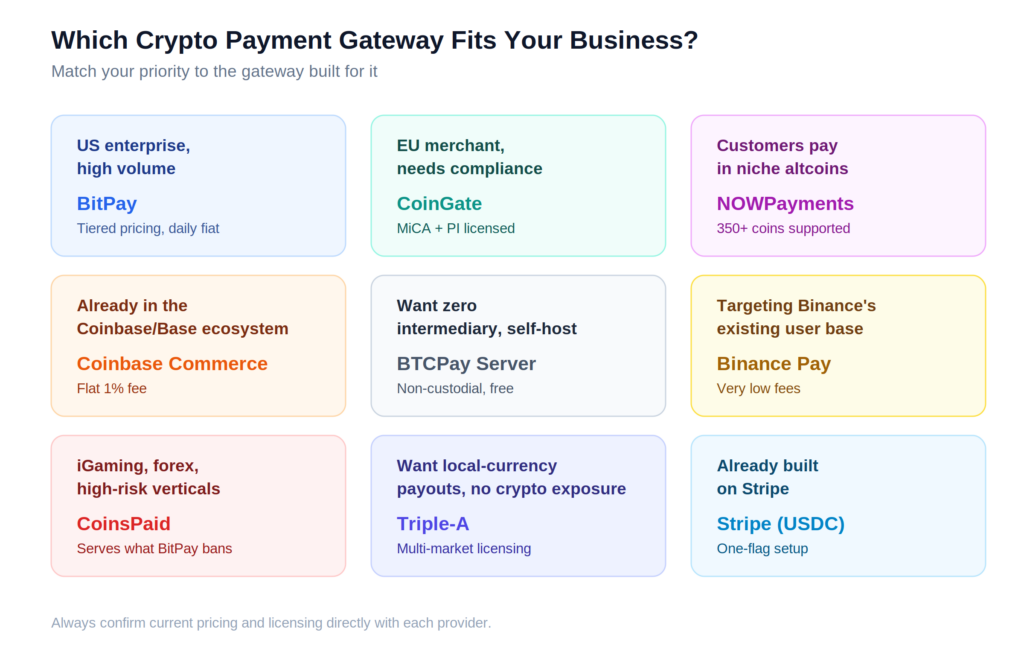
Which crypto payment gateway fits your business
- US-based, high-volume enterprise → BitPay, due to their tiers and fiat settlements every day.
- EU merchant needing compliance → CoinGate, for its MiCA + PI licensing.
- Store whose customers pay in niche altcoins → NOWPayments, for the widest coin list.
- Already using the Coinbase / Base ecosystem → Coinbase Commerce.
- Want zero intermediaries and full sovereignty? → BTCPay Server if you have the technical capacity to self-host.
- Targeting Binance’s existing user base → Binance Pay.
- iGaming, forex, or other high-risk verticals → CoinsPaid or a specialist high-risk processor, since BitPay and Coinbase explicitly exclude these industries.
- Want predictable local-currency payouts without touching crypto → Triple-A.
Stripe’s return to crypto
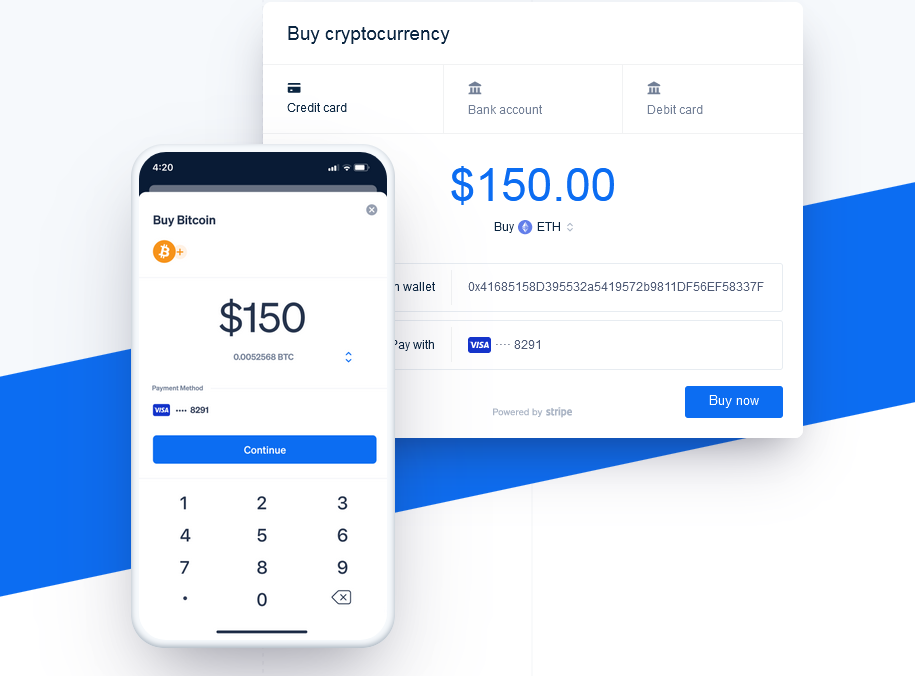
Stripe re-entered the crypto payment space with USDC-based stablecoin payments on Ethereum, Base, and Polygon, charging 1.5% on stablecoin checkouts – lower than its standard 2.9% + $0.30 card rate. Funds settle to a merchant’s existing Stripe balance, either paid out in USD or held in USDC. For businesses already built on Stripe Checkout or the Payment Element, enabling stablecoin payments is close to a one-flag setting rather than a separate integration – worth considering before adding a dedicated crypto gateway.
How to integrate a crypto payment gateway
- Compare providers against the criteria above and shortlist two or three.
- Register and complete KYC/KYB where required – most custodial processors take a few business days to approve a merchant account; fully non-custodial options like BTCPay require none.
- Pick an integration method – either through native plugins (WooCommerce, Shopify, Magento, PrestaShop, WHMCS), using a hosted payment link for codeless integration, or via API integration.
- Choose your settlement currency – keep crypto, automatically convert to stablecoin, or settle in fiat.
- Test in sandbox mode before going live – ensure that webhooks, payment confirmation events, and refund capabilities work properly.
Avoiding common mistakes
- Don’t select a gateway just because of a lower percentage – spread of conversions, withdrawal fees, and minimum per month may become even more expensive.
- Don’t think that the more supported cryptocurrencies you have, the better your service will be – since most people are using either Bitcoin, Ethereum, or any popular stablecoin anyway.
- Don’t ignore the custody model – a pooled custodial wallet is convenient, but it’s also a bigger target; per Chainalysis, 2025 alone saw roughly $3.4 billion in crypto stolen.
- Don’t skip checking industry restrictions – gambling, adult content, and several other verticals are explicitly banned by BitPay, Coinbase, and many mainstream providers.
Findings
There is no one-size-fits-all “perfect” cryptocurrency payment gateway, as your choice will depend on what matters to you most between fiat settlement and custody control, whether your customers prefer paying in Bitcoins or different altcoins, and whether your company belongs to the type that conventional payment processors are not ready to accommodate. The BitPay and CoinGate solutions are recommended for businesses that value compliance and fiat settlement reliability; the NOWPayments and Plisio solutions can work for those who want to minimize fees and support all altcoins; the BTCPay Server solution will fit businesses that need cases where no insurance is needed.