
All round-ups sort them by a single number: commission percentage. This is by far the least interesting aspect of any affiliate program. What really matters is payment speed, its frequency, and the percentage of traffic you convert.
The top ten cryptocurrency affiliate programs below are ranked according to different criteria.
Where the funnel breaks
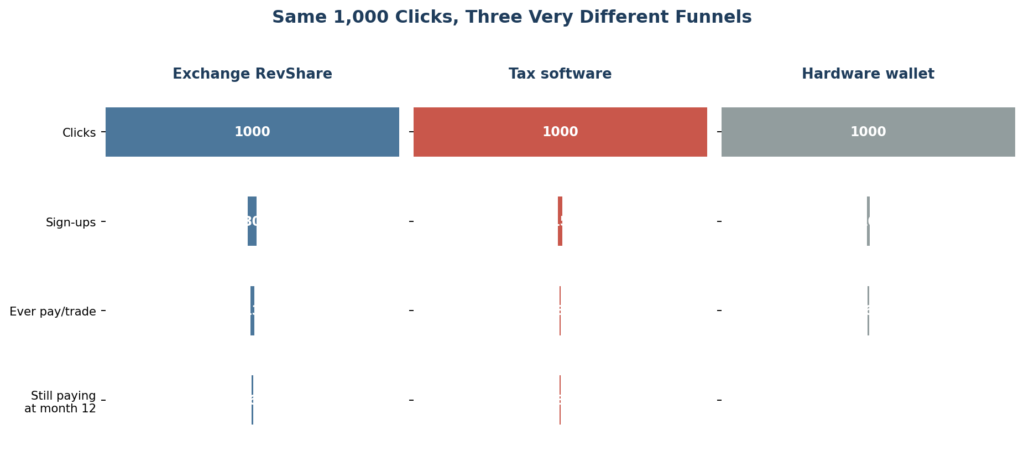
Same 1,000 clicks, three very different leaks. Exchanges fail at everyone on the sign-up stage – it takes KYC, deposit, real intentions – but from those who remain, some keep paying year after year. Tax preparation software fails at fewer people at the sign-up stage, converts them right away, and never again, for the entire relationship. Hardware wallets convert the fastest out of the three and then go dead flat – same numbers at month 12 as at month 2.
The shape of money
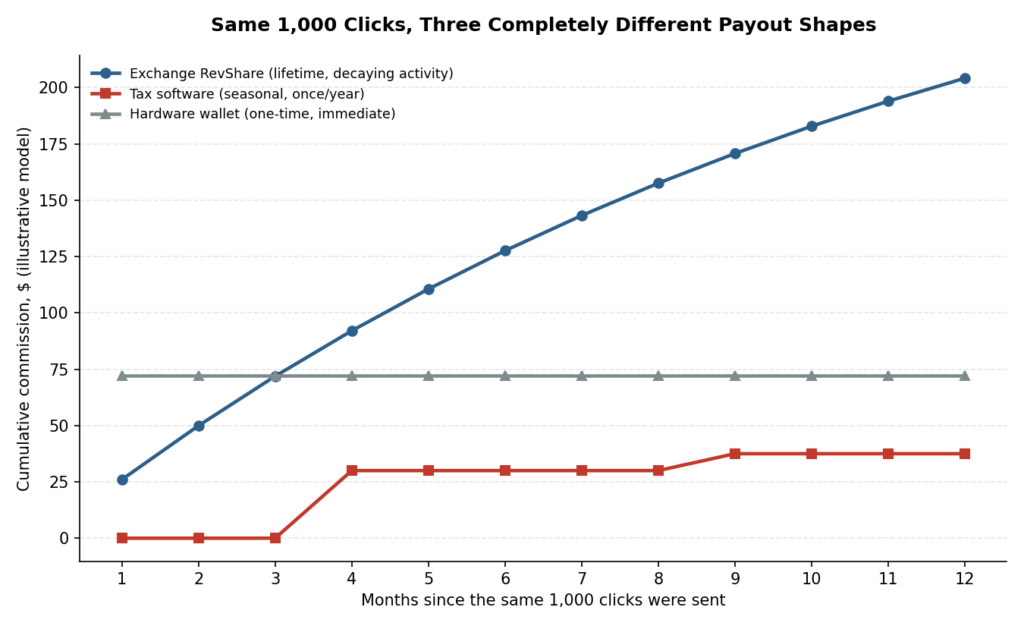
Run those funnels for a year, and the leaks will become curves. The Exchange RevShare program begins from 0 and compounds as long as the referred trader keeps trading. Tax software remains flat for eleven months and spikes once during tax filing season. Hardware wallets make a single immediate payment that is final.
The patience premium

Push the curve out beyond where other roundups usually end, and you get an interesting result. The compounding RevShare program doesn’t start early. For several months, it is a better offer than the immediate payment on paper. The compounding RevShare line becomes advantageous only when you retain more active users than you get from one-time payments.
Ten Programs, Ten Payout Curves
OKX – where you get paid before you forget the reason

Hourly payments. Not daily, not monthly, but hourly. With an extra level of sub-affiliates (recruit your affiliates and get commission on their referrals) and a 30%-50% tier structure, OKX becomes the perfect program for impatient individuals who cannot wait on dashboards.
- 30% base tier to 50% (or even 60% in certain areas), evaluated each month according to volume
- Overriding system of sub-affiliate, without any additional application except standard tiers
- No per-referral cap while the account continues active
The catch: monthly rate reassessment means income moves around more than the “up to 50%” headline suggests.
Pros
- Payments on commissions are extremely fast
- Good fit for trading audience
- Sub-affiliate model adds another revenue stream
- No fixed limit per referred user
Cons
- Commission percentage may vary monthly
- Higher levels require a steady amount of traffic
- Less predictable earnings for smaller publishers
Bybit – the compliance-first exchange play
Bybit operates a second MiCA-licensed company (Bybit.eu) to keep EU-based affiliates out of grey zones. This is less common than you think because in this business there is no need to tell publishers what to do.
- 30-50% Revenue Sharing + 10% Sub-Affiliate Override
- Payments daily, minimum threshold not applicable, 5 currency options
- European Union parallel program aimed at being compliant with MiCA marketing regulations
The catch: the 10% override only pays if you’re actually recruiting other affiliates – referring end users alone doesn’t count.
Pros
- Payments daily
- Ideal for content based on trading
- Separate structure for EU is good for European users
- Sub-affiliate option can increase total earnings
Cons
- Sub-affiliate revenue requires recruiting other affiliates
- Terms can vary between the global and EU programs
- Less useful if your audience mainly wants simple crypto purchases
Binance – the name that closes the sale for you

Nobody converts a skeptical reader faster than a brand they’ve already heard of on the news. That’s Binance’s entire edge – the rate itself is average for the category.
- 20-50% of trading fees, with no limit on time
- Top levels accessible only through invitation to become an influencer
- Payouts awarded to affiliates achieving a certain commission per month.
The catch: the 50% headline is largely aspirational – most new affiliates sit well below it.
Pros
- Very strong brand recognition
- Easy to introduce to beginners
- Long-term referral potential
- Works well for broad crypto content
Cons
- Highest commission tiers are not easy to access
- Smaller affiliates may receive lower rates
- Payout conditions can restrict flexibility
KuCoin – built for the altcoin reader, not the BTC maximalist

The highest published ceiling of the four majors (60%) matched to the identity that earns it – KuCoin lists small-cap tokens before bigger exchanges touch them, so its audience fit is narrower and sharper than Binance’s.
- Up to 60% cap, graduated depending on referred volumes
- 30 million+ users registered – valuable branding for altcoin marketing
- Same ceiling based on volume issue as every tiered referral program
The catch: reaching 60% needs sustained referred volume – new affiliates start much lower.
Pros
- Well-suited to an altcoin-oriented audience
- High commission ceiling
- Established user base
- Applicable to articles about lesser-known cryptocurrencies
Cons
- High commission requires high trade volume
- Not ideal for conservative cryptocurrency traders
- Earnings can be difficult to predict at lower traffic levels
Coinbase – rented trust, three months to use it
Coinbase doesn’t need a lifetime deal because the brand does the conversion work most RevShare percentages exist to do. It runs through Impact, not an in-house dashboard – better attribution, worse duration.
- Up to 50% of trade commissions, but no more than 3 months for each referral
- Impact Network: More than 20 report types, deep links, campaign tests
- Payments in local currencies, not only crypto
The catch: the cap. None of these exchange affiliate programs sacrifices its long-term potential for short-term shine.
Pros
- Good name among novices
- Impact arrives with comprehensive reporting options
- Payment system operates in local currency
- Suitable for educational content about cryptocurrencies
Cons
- Earnings from referrals work for a certain period only
- Shorter earning window reduces long-term value
- Less attractive for audiences that trade infrequently
Crypto.com – the sponsorship-brand play for non-crypto readers

Formula 1, UFC, a Visa card – Crypto.com sells crypto to people who don’t think of themselves as “crypto people” yet. Wrong fit for advanced-trader content, right fit for lifestyle and consumer finance.
- Many products available: referrals, trading cards, applications
- Terms differ according to geography and contract – less uniform compared to other firms
The catch: without published flat rates, you’re negotiating case by case rather than reading a rate card.
Pros
- Attracts people who are not part of the primary crypto target market
- Multiple products create more promotional opportunities
- Strong consumer-facing brand
- Good fit for lifestyle and personal finance content
Cons
- Terms of affiliates differ from one region to another
- No simple universal commission structure
- Harder to estimate earnings before joining
Nexo – the longest leash in the list

12-month tracking beats every 30-day cookie on this page. If your content gets read weeks after publishing – which most content does – Nexo is the only program here still crediting you for it.
- 8% cap on borrowed funds and proportionate fees on swaps and Futures
- Attribution period of one year and 30-day release period
- $20 bonus after three Nexo Card transactions
The catch: low cap in comparison with the trading-fee-based RevShare offering – that’s what the story of yield is all about.
Pros
- 1-year attribution period
- Ideal for finance-related content and lending products
- Lengthier tracking helps pick up delayed conversion actions
- Ideal for users knowledgeable about crypto finance
Cons
- Lower commission ceiling than major exchange programs
- More specialized audience requirement
- Less suitable for basic crypto-buying content
CoinLedger – the reason your “best exchange” post isn’t your only post
Lower rate, higher real-world payout — the EPC anomaly that opens this article. Almost every reader who already trades needs this exact product once a year, no matter which exchange they use.
- 25% recurring – renews every year when the referral renews
- $30 minimum payment per month, either through PayPal or bank transfer
- Integration with TurboTax expands the base to non-crypto people
The catch: 15-day cookie – the shortest on this list – and the demand rises during tax season.
Pros
- Annual commission
- Relates to current cryptocurrency traders
- Can be supplementary to exchange-based content
- TurboTax integration expands its audience
Cons
- Very short 15-day cookie window
- Demand is heavily influenced by tax season
- Less possibility out of the tax season
Koinly – CoinLedger’s steadier, quieter sibling

Same mechanism, roughly 20% instead of 25% – worth running alongside CoinLedger rather than instead of it, since neither program penalizes you for having both links in the same article.
- ~20% recurring commission on subscriptions
- Same seasonal demand curve as CoinLedger
The catch: no meaningful edge over CoinLedger except as a second option to A/B test.
Pros
- Recurring subscription commissions
- Easy to position alongside exchange content
- Useful for tax-focused crypto audiences
- Can work well as an alternative to CoinLedger
Cons
- Lower commission than CoinLedger
- Strong seasonality around tax deadlines
- Limited differentiation for publishers promoting several tax tools
Ledger – the only program that doesn’t need a crypto-native reader
Ten percent, paid once, in Bitcoin – the lowest rate here by a wide margin, and also the only one that converts readers who’ve never touched an exchange. “How do I not get hacked?” content sells Ledger better than any trading pitch sells an exchange.
- 10% of net sales amount, one-off, made using BTC
- No KYC-style restrictions – converts those who are cold and security-conscious
The catch: no more ongoing income, ever – one wallet, one fee, that’s it.
Pros
- Simple product that is easy to explain
- Appeals to security-conscious beginners
- Does not depend on users actively trading
- Good fit for wallet and crypto-security content
Cons
- Commission is paid only once
- No recurring revenue from the same customer
- Lower earning ceiling than exchange RevShare programs
How long a click stays yours
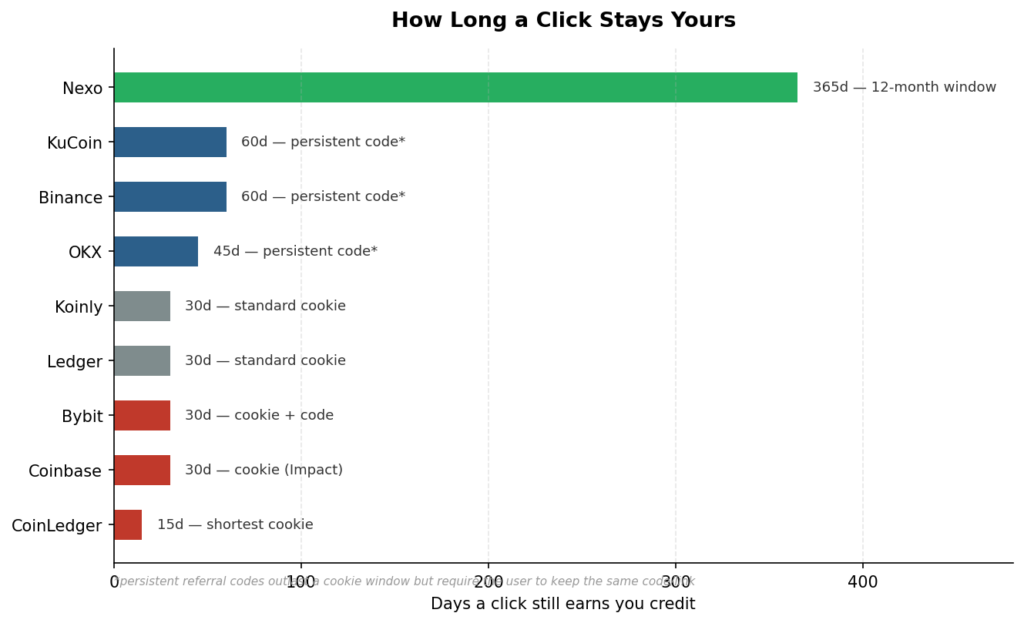
CoinLedger’s 15-day cookie window is by far the shortest leash on this list; bookmarking your article and purchasing the following month means losing the entire commission. Nexo’s 12-month period lies on the other end of the spectrum and is actually twelve times longer than the standard industry cookie of 30 days. Exchanges with persistent referral codes (OKX, Binance, and KuCoin) are longer-lasting than any cookie in theory, but not necessarily in practice.
The seasonality fingerprint

Put all three categories on a calendar, and the discrepancy is clear: tax software fires once per year, then shuts down for the other 11 months of the year; hardware wallet quietly peaks around the holiday season; while the only exception in the group is RevShare of exchanges, because they don’t even have an off-season since they don’t take their holidays off either.
Where they sit
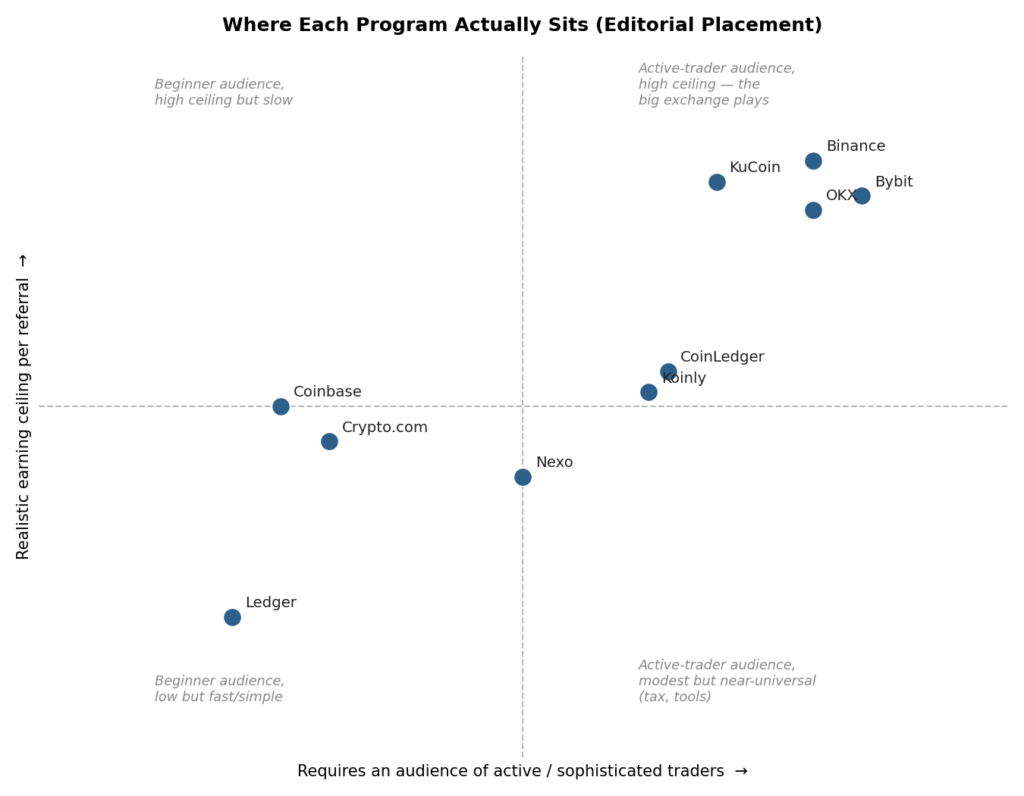
RevShares for Exchanges can be found in the upper right-hand corner: they require a trader audience and offer the highest payout if you have such an audience. Coinbase and Crypto.com sit in the lower middle-left corner: lower requirements and a lower ceiling. CoinLedger and Koinly occupy the middle right-hand corner: still require crypto-inclined audiences, but are more dependable. Ledger stands alone in the lower left-hand corner: lowest ceiling and requirements.
One trade-off in graphic form: OKX/Bybit rule in speed and ceiling, sacrifice regulatory freedom. CoinLedger/Koinly are the inverse of that – small ceiling, maximum freedom.
Reference table
| Program | Commission | Cadence | Tracking window | Risk |
|---|---|---|---|---|
| OKX | 30–50% (up to 60% regional) | Hourly | Persistent code | Medium |
| Bybit | 30–50% (+10% sub-affiliate) | Daily | 30d + code | Medium |
| Binance | 20–50% (top tiers gated) | Periodic | No cap | Med-high |
| KuCoin | Up to 60% (tiered by volume) | Periodic | Code-based | Med-high |
| Coinbase | 50% (capped, 3 months) | Monthly | 30-day cookie | Medium |
| Crypto.com | Varies (by region/deal) | Varies | Varies | Medium |
| Nexo | Up to 8% (+ fee share) | Monthly | 12-month | Low-med |
| CoinLedger | 25% (recurring yearly) | Monthly | 15-day cookie | Low |
| Koinly | ~20% (recurring yearly) | Monthly | Standard cookie | Low |
| Ledger | 10% (one-time, in BTC) | Periodic | Standard cookie | Low |
Pick by traffic, not by rate
- You target an audience that is already trading → OKX or Bybit (more effective and structured), KuCoin (audiences interested in cryptocurrencies), Binance (your brand will work just fine)
- Your audience is crypto-curious, but not crypto-converted → Coinbase, Crypto.com
- You are already writing for exchanges → add CoinLedger, Koinly – your purchase is inevitable
- Content touches custody or security → Ledger, full stop
- Audience does DeFi lending/yield → Nexo
Findings
There is always more than meets the eye – the graph that generates it tells all. The RevShare model reinvests and takes a few months to start generating profits, whereas software and hardware investments generate profit immediately but plateau soon enough. Mix both and savor unmatched returns on investment.