
A regulator does not ask, “Did you do KYC?” but rather, “Where did this particular batch of USDT originate six wallet hops ago?” These are two very different questions, and they require two different products, which are almost always purchased from two different vendors – and that is the most costly mistake a compliance budget can make.
Crypto AML isn’t one market but three: forensics (who did what move, provably?), screening (is this wallet currently dirty?), and Travel Rule (can I legally share my data with the counterparty?). The majority of the vendors mentioned below are good at one but okay at the other two.
The stack
All VASPs end up building a four-layer stack, whether by design or not, that looks like this:
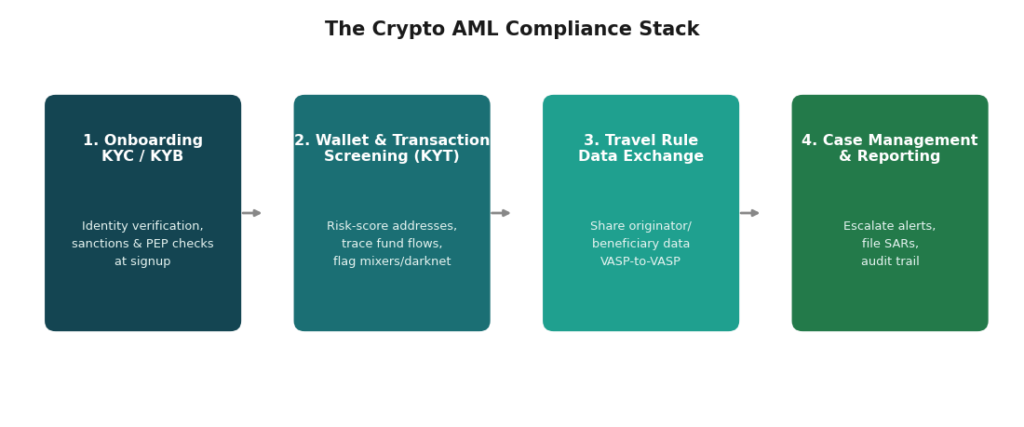
By 2026, 85 of 117 monitored jurisdictions enforce Travel Rule law, and the EU removes the usual $1,000 floor entirely for VASP-to-VASP transfers. Step three stopped being optional for anyone touching Europe – regardless of size.
Where the ten sit

Nobody is both cheap and forensically deep at once. That single fact explains why most VASPs run two vendors instead of one. Notabene isn’t even trying to compete on this axis – which is exactly why it works alongside anyone else on the list.
The forensics tier
Chainalysis

Chainalysis is a well-known cryptocurrency compliance solution that offers blockchain analysis, transaction monitoring, and risk detection services. Chainalysis serves many exchanges and financial institutions with complicated cases.
Pros
- Excellent reputation in the industry
- Comprehensive transaction analysis
- Extensive blockchain coverage
- Useful for complicated compliance cases
Cons
- High cost
- Can be complex for smaller teams
- Some tracing is based on probability analysis
Best for: admissible evidence and big cases
Standout: Attribution in Reactor is based mostly on law enforcement experience in the field, and not on public data – 1,500+ entities, 100+ blockchains, approx. 150 DeFi protocols
Price signal: highest-priced option listed; available only for enterprise and customization
Watch out: DeFi tracing and cross-chain tracing are heuristic-based, not certain
Elliptic

Elliptic provides blockchain intelligence and AML monitoring with a strong focus on cross-chain activity. Its tools help businesses identify risky wallets, transactions, and connections across multiple networks.
Pros
- Excellent cross-chain visibility
- Wide bridge coverage
- Focus on compliance in Europe
- Comprehensive risk analysis
Cons
- High prices for enterprises
- More difficult to learn
- Investigation tools can be less flexible than Chainalysis
Best for: cross-chain and hop-on-hop-off bridge assessment, compliance assessment for EU/UK exchanges
Standout: “Holistic Screening” looks at 1,100+ networks and 1,130+ bridges as a single graph rather than separate chains
Price signal: enterprise, custom – equal to Chainalysis
Watch out: investigation tools lag behind Reactor for the toughest adversaries
TRM Labs

TRM Labs combines blockchain analytics, transaction monitoring and risk detection in one platform. It is a strong choice for crypto businesses that need automated monitoring as transaction volumes grow.
Pros
- Excellent automation
- Effective stablecoin monitoring
- Excellent network coverage
- Capacity for growth of the business
Cons
- May be costly for small VASPs
- Varies in regulatory coverage by region
- Some complex features may need customization
Best for: rapidly expanding CASPs focusing on automation and flow of stablecoins
Standout: best in terms of attribution on Solana, Tron, Polygon, and flow of USDT/USDC
Price signal: €60,000-150,000 per year for a medium-sized CASP – underpriced relative to competitors
Watch out: fewer EEA regulators compared to Ellipt
Merkle Science

Merkle Science focuses on detecting suspicious blockchain activity through transaction monitoring and behavioral analysis. It is particularly useful for businesses dealing with a broad range of tokens and networks.
Pros
- Good behavioral analysis
- Good altcoin analysis
- Automated risk detection
- Adaptive compliance solutions
Cons
- Small enterprise presence worldwide
- Custom pricing
- Not appropriate for complex investigations
Best for: platforms where there is extensive exposure to altcoins via long-tail, APAC-focused VASPs
Standout: Behavior Rule Engine identifies illicit behaviors prior to transactions being completed
Price signal: only available on a customized basis – there is no standard pricing structure
Watch out: less enterprise presence outside of APAC
Crystal Intelligence
Crystal Intelligence offers blockchain analytics services and AML monitoring for banks and other cryptocurrency-related firms. It allows users to configure their own risk models to fit their needs.
Pros
- Coverage of all blockchains
- Flexible risk models
- More affordable than premium players
- Suitable choice for mid-sized VASPs
Cons
- Limited data ecosystem
- Not very powerful in big cases
- Some customization may be required
Best for: financial companies and mid-tier VASPs needing forensic services at lower prices
Standout: supports 330+ blockchains, risk engine is built to be customizable to reduce false positives; plays a role in developing regulations in the UK and Europe
Price signal: mid-market – a real move down from the top 3
Watch out: smaller law-enforcement data pipeline than Chainalysis or Elliptic
The compliance-ops tier
Sumsub

Sumsub combines KYC, AML screening, transaction monitoring, and Travel Rule tools within one compliance platform. It is a practical option for companies that want to manage several compliance processes through one provider.
Pros
- KYC & AML solution in one package
- Compliance with Travel Rule
- Simple onboarding
- Good option for small teams of compliance officers
Cons
- Limited forensic capabilities
- Not a specialist blockchain investigation tool
- Verification cost increases with higher numbers of verifications required
Best for: VASPs in need of a one-stop-shop solution for customer onboarding, AML, and Travel Rule
Standout: KYC + sanctions/PEP + monitoring + Travel Rule to 1,800+ VASPs, all in one agreement
Price signal: from $1.35 to $1.85 per verification – simple and cost-effective
Watch out: AML is placed on top of an ID verification solution, rather than being a forensic tool
AMLBot

AMLBot provides crypto businesses with wallet screening, KYC, and AML checks through a relatively simple setup. It targets smaller companies that need basic compliance controls without a large enterprise platform.
Pros
- Inexpensive to get started
- Simple integration via the API
- More streamlined wallet screening procedure
- Best suited for small firms
Cons
- Limited cognitive abilities
- Unsuitable for conducting deep analyses
- Less blockchain intelligence than specialist platforms
Best for: small exchanges, OTCs, cryptocurrency ATM vendors with limited budgets
Standout: integrates KYC and wallet verification into one API; also provides ad hoc wallet verification for individuals who have had their cryptocurrency stolen
Price signal: the lowest barrier to entry on this list
Watch out: limited data compared to the forensics five – good for compliance yet not sophisticated cases
ComplyAdvantage
ComplyAdvantage focuses on sanctions screening, AML risk detection, and compliance management. It works particularly well for crypto companies that also need traditional financial crime screening alongside blockchain monitoring.
Pros
- Advanced sanctions filters
- Adverse media scan
- Strong case management
- Known to financial compliance experts
Cons
- Weak blockchain investigation
- Requires separate KYT vendor
- Not designed for transaction tracing
Best for: crypto companies that require financial technology level sanctions and case management solutions
Standout: Leader Category Chartis for sanctions & adverse media screening in 2026
Price signal: subscription pricing model
Watch out: poor blockchain scanning when compared to any KYT tool
Scorechain

Scorechain offers blockchain analysis, AML monitoring, and Travel Rule compliance functionality for crypto businesses. The product features make it especially well-suited to small and medium-sized virtual asset service providers in the EU.
Pros
- AML and Travel Rule functionalities combined
- Highly European-oriented
- Good fit for small VASPs
- Fairly simple to set up
Cons
- Less forensic power than other solutions
- Inappropriate for more sophisticated investigations
- Growing businesses may need additional tools
Best for: small/medium size VASPs that require compliance with Anti-Money Laundering and Travel Rule requirements
Standout: built-in compatibility with Notabene – don’t need to purchase any additional solutions for Travel Rule compliance
Price signal: moderate, oriented towards Europe
Watch out: limited chain analytics compared to the top five
The Travel Rule specialist
Notabene
Notabene is a specialized Travel Rule platform that helps VASPs exchange required transfer information with counterparties. It complements blockchain screening and transaction monitoring tools rather than replacing them.
Pros
- Travel Rule solution
- High-speed data transfer from VASP to VASP
- Compatible with other compliance tools
- Applicable to regulated marketplaces
Cons
- No wallet scanning capability
- No transaction monitoring capability
- Requires another provider for wider AML coverage
Best for: a nearly-complete stack that is just missing Travel Rule
Standout: exchange of information between VASPs, verification of unhosted wallets according to EU standards; integration with Scorechain, more TRM Labs integrations
Price signal: price for connecting one VASP to another, not the price of the AML stack
Watch out: no wallet screening nor transaction monitoring functionality – requires a KYT vendor too
Which one do you actually need
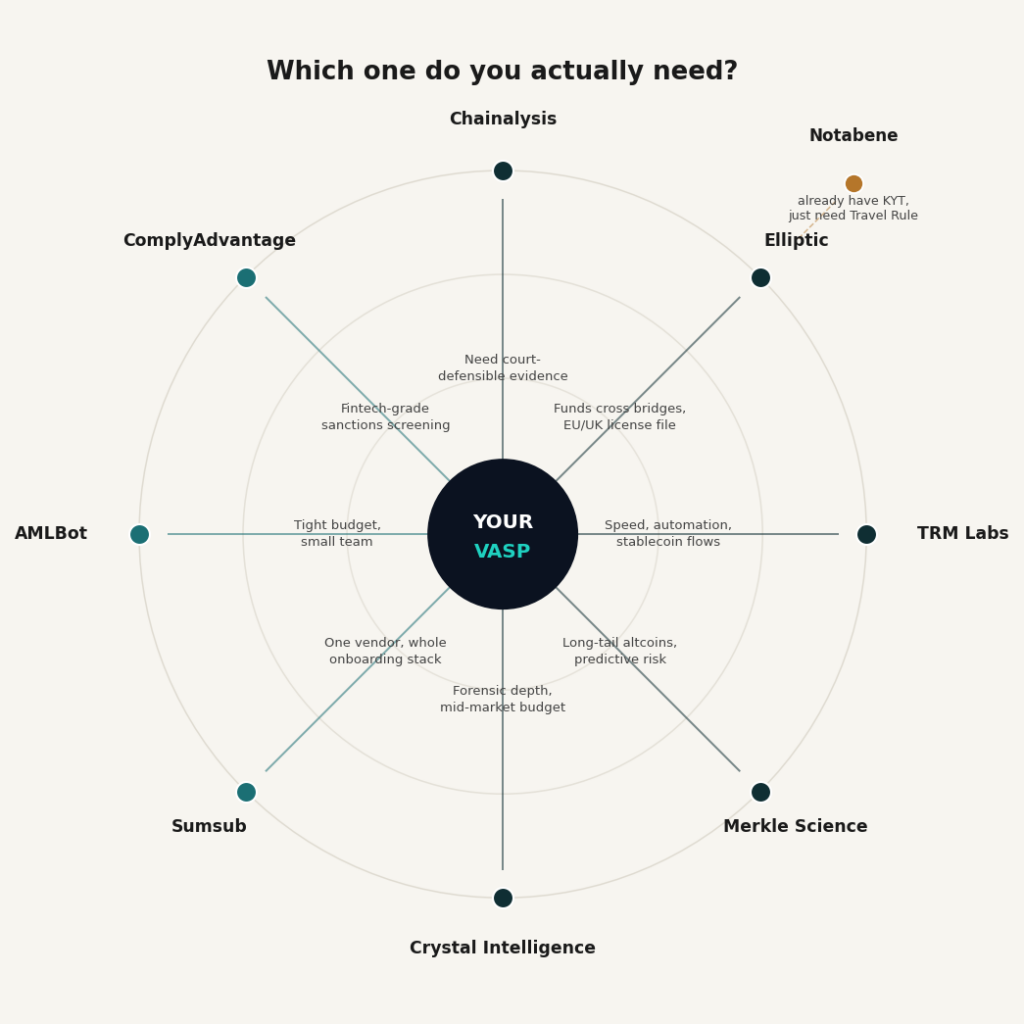
A shortcut around the feature-by-feature comparison: match your actual constraint to the vendor built around it
Retire this name
CipherTrace is another company that comes up in older compilations. Mastercard bought it out in 2021, and as of early 2024, it was telling customers it was shutting down Armada, Inspector, and Sentry.
One nuance worth keeping straight when you cite this: Mastercard has been explicit that CipherTrace as a company was not shutting down entirely, only those three products – a distinction a Mastercard spokesperson drew directly with Fortune at the time. The shutdown also followed Mastercard’s own decision to pull a CipherTrace expert’s court testimony after questions about the underlying data’s verifiability, which is a separate credibility flag worth knowing if this name comes up in a legal or licensing context rather than just a procurement one.
Where teams get it wrong
- Buying Reactor-grade investigations tooling for a first compliance program that only needed onboarding and Travel Rule.
- Trusting “100+ blockchains supported” without checking whether customers’ actual chains – usually Tron and Solana for stablecoins – get the same depth as Bitcoin and Ethereum.
- Ignoring false misdetection rates until they cost more in blocked real customers than the fines they prevented.
- Assuming the EU’s zero Travel Rule floor doesn’t apply just because a transfer sits under FATF’s usual $1,000 line.
- Treating “the counterparty’s jurisdiction has Travel Rule legislation” as equivalent to “the counterparty is actually supervised on it” – FATF’s 2026 review found only 40% of jurisdictions with a law on the books have taken real enforcement action, so the legal floor and the practical risk floor are not the same line.
What getting it wrong actually costs
None of the vendors above are cheap, but the numbers on the other side of the ledger make the spend look small. Crypto exchanges were the single most-fined category of financial business for AML/CFT failures in 2025, according to research from the Institute for Financial Integrity – more than money transmitters, securities firms, and casinos combined. A few of the individual cases put that in perspective:
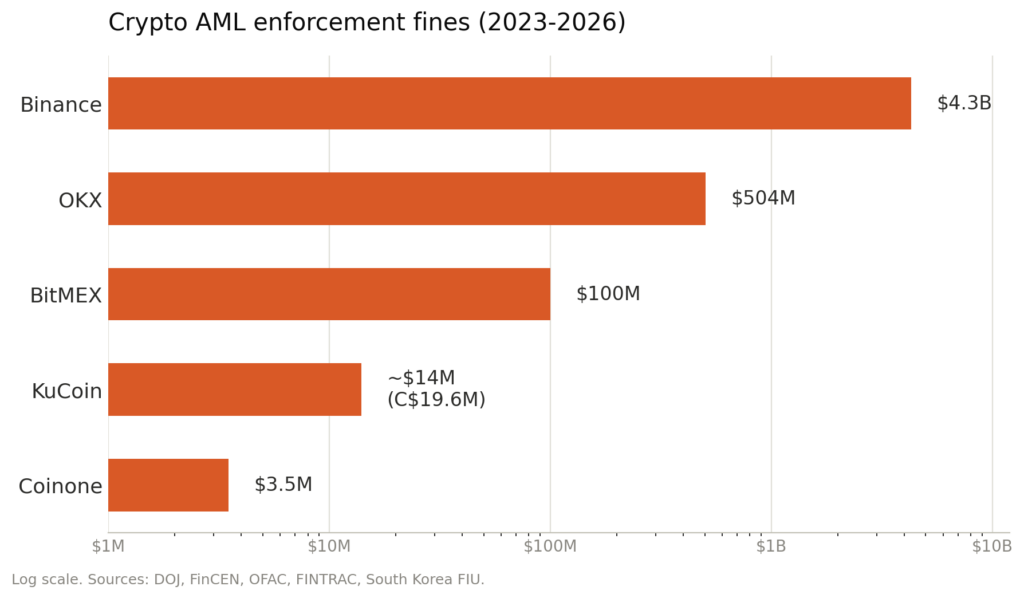
- Binance – $4.3 billion in fines by the US DOJ, FinCEN, and OFAC (2023), the biggest corporate crime penalty in crypto history, because of a lack of KYC measures and handling transactions linked to sanctions against certain organizations.
- OKX – $504 million paid to the US Department of Justice (February 2025) due to insufficient KYC screening that allowed billions of suspicious transactions to go through.
- BitMEX – $100 million (2025), an extension of US enforcement pressure on exchanges with historically thin AML programs.
- KuCoin – $19.6 million, the largest domestic crypto AML penalty Canada’s financial intelligence unit (FINTRAC) has ever issued.
- Coinone – $3.5 million from South Korea’s Financial Intelligence Unit (April 2026), for multiple identified AML failures.
The common denominator in almost all of these cases is three consistent deficiencies, in the same sequence: poor KYC practices at onboarding, ineffective transaction monitoring, and a lack of sanctions screening that let illicit activity proceed uninterrupted for months and years until someone discovered it.
The actual takeaway
It’s rare to find a VASP that uses just one AML service provider – most use two, with a forensics-grade choice for wallet risk, along with an AML compliance and operations suite or Notabene for client onboarding and Travel Rule. “Which is better” is not the right question; “what is missing” is.