

Crypto referral programs let existing users earn rewards by inviting friends to a crypto exchange, wallet, or investment platform. The reward may depend on a deposit, trade, investment, or product purchase rather than a simple sign-up.
If you are promoting crypto services to a wider audience through a website, social media, or a content channel, the model is different. Our Best Crypto Affiliate Programs guide focuses on affiliate programs built around audience-based promotion and commissions. This article focuses specifically on referral programs built around personal invitations.
How crypto referral programs work
The referral process can be broken down into four steps: Share a link → Friend signs up → Friend completes a qualifying action → Referral is verified → Reward is credited.
The important part is the qualifying action. For MEXC, the current program requires a deposit and Futures trading. CEX.IO’s September 2026 promotion requires a first fiat deposit of at least $100. Bitpanda requires the invited user to invest at least €500 in crypto or Bitpanda Crypto Index products.
Top 10 crypto referral programs
1. MEXC Referral Program

MEXC’s current Invite & Earn campaign uses a two-layer reward structure. A qualifying friend needs to make a cumulative net deposit of at least 100 USDT and complete Futures trading. Base rewards reach 140 USDT, while additional referral rewards can add up to 220 USDT, bringing the current maximum to 360 USDT. The rewards aren’t necessarily paid entirely as withdrawable USDT; MEXC says they can include bonuses, fee vouchers, token airdrops, and position airdrops, depending on the campaign.
Pros
- Large possible benefit from campaign
- Rewards can go to both users
- Tiered structure encourages multiple referrals
Cons
- Requires Futures trading
- Higher rewards require higher trading volume
- Reward types can include vouchers and bonuses, not only USDT
2. Gate US Referral Program

Gate US currently runs referral campaigns where both the referrer and friend can receive rewards after the new user completes KYC and reaches qualifying spot-trading activity. In the current campaign, rewards range from 10 to 20 USDT per eligible referral, depending on the number of successful referrals.
Pros
- Both users can receive rewards
- Clear trading milestones
- Rewards increase with successful referrals
Cons
- Gate. US availability is jurisdiction-specific
- KYC is required
- Trading activity is required
3. CEX.IO Referral Program

The CEX.IO September 2026 Referral Program bonus will provide each referrer and new customer with 25 USDC for every qualifying referral. To qualify for the program, the new customer must sign up via the referral link, verify their account, and deposit at least $100.
Pros
- Reward system already established for both parties
- Simple deposit of $100
- Time frame of promotional period stated
Cons
- Short duration of campaign
- Restrictions on countries
- Only the first 100 qualifying referrals count
4. Robinhood Referral Program

Robinhood uses a milestone system in its referral program instead of offering an amount on each friend referral. Starting September 1, 2026, US-eligible users can receive up to $15,000 in reward stocks annually by meeting referral milestones. The first milestone is one qualifying referral that rewards the user with $50, with subsequent milestones offering higher rewards.
Pros
- High annual reward ceiling
- Milestone-based structure
- Rewards are provided as stock
Cons
- US residents only
- Friend must successfully fund the account
- Rewards are tied to particular milestones rather than every referral
5. Tangem Referral Program

Tangem keeps its referral model simple. The invited customer receives 10% off a Tangem Wallet purchased with the referral code, while the referrer receives 5 USDT for each wallet purchased through the code. Tangem states that there is no limit on the number of referrals, although rewards are paid 30 days after the promotional code is used for a purchase.
Pros
- Fixed 5 USDT reward
- 10% discount for the friend
- No referral limit
Cons
- Requires a Tangem Wallet purchase
- Reward is paid after 30 days
- Only qualifying Tangem purchases count
6. Trezor Refer-a-Friend

Trezor’s program is built around hardware wallet purchases. A referred customer gets 10% off their first Trezor Shop order, while the referrer receives $20 in Trezor Shop credit. The current program allows up to 50 referrals, giving a maximum of $1,000 in store credit. The reward is paid 21 days after the friend’s order is paid.
Pros
- Fixed $20 reward
- 10% discount for the friend
- Up to $1,000 in total store credit
Cons
- Reward is store credit
- Requires a Trezor purchase
- 21-day reward waiting period
7. Bitpanda Tell-a-Friend

The Bitpanda Tell-a-Friend referral program offers up to €100 per referred person. The first reward tier requires the referred client to invest at least €500 in crypto or the Bitpanda Crypto Index. Higher investments result in higher rewards, up to €100 per referred person. The program differs from Bitpanda’s affiliate program.
Pros
- Up to €100 per person
- Both users can receive rewards
- Several investment tiers
Cons
- €500 minimum investment for the first reward
- Not available in the UK
- Only qualifying crypto and BCI purchases count
8. Uphold Referral Program

Uphold currently pays $20 worth of Bitcoin to the eligible referrer and referral user. The invited person must be a new Uphold customer, register via the referral link, get verified, deposit at least $100, and make a transaction of at least $100 from a national currency to cryptocurrency. Under the current terms, the promotion runs until December 31, 2026, but Uphold may modify or stop it.
Pros
- Both parties get BTC
- Fixed $20 reward
- Clear qualification requirements
Cons
- Not available in Europe under the current terms
- $100 funding requirement
- $100 crypto transaction required
9. Revolut Crypto Referrals

Revolut’s Crypto Referrals program connects the reward to a qualifying crypto purchase. The invited user must follow the unique referral link and buy the required amount of crypto shown in the referrer’s app. The reward is paid in crypto, and the exact amount can depend on the referrer’s location. The current terms allow up to 10 rewards per referrer, with additional daily, weekly, and monthly invitation limits.
Pros
- Crypto reward
- No fixed public reward amount
- Can invite multiple people
Cons
- Reward amount varies
- Required purchase amount is shown in-app
- Maximum of 10 paid rewards under the referenced terms
10. CoinEx Referral Program

CoinEx uses a trading-based referral model. When a new user registers through a referral link or code and trades, the referrer can receive a percentage of the referred user’s trading fees as referral rewards. CoinEx’s current referral information explains that the reward increases with the number of invited users and their trading activity.
Pros
- Trading-based system
- Bonuses may increase depending on referrals
- Referral link/ID
Cons
- Requires the referred user to trade
- Reward depends on trading activity
- Not a fixed bonus for registration
Comparison: how the programs actually work
| Program | What triggers the reward? | Reward model | Friend’s benefit | Best fit |
|---|---|---|---|---|
| MEXC | Deposit + Futures trading | Tiered crypto rewards | Trading rewards | Active traders |
| Gate | Registration + qualifying trading | Trading-based rewards | Depends on campaign | Exchange users |
| CEX.IO | Qualifying deposit | Fixed crypto reward | 25 USDC in current September promo | New crypto users |
| Robinhood | Funded new account + referral milestones | Stock rewards | Account-opening benefit | Investors |
| Tangem | Wallet purchase | 5 USDT | 10% discount | Hardware-wallet buyers |
| Trezor | Qualifying shop purchase | $20 store credit | 10% discount | Hardware-wallet buyers |
| Bitpanda | €500+ investment | Tiered reward | Up to €100 | Investors |
| Uphold | $100 funding + $100 crypto transaction | $20 BTC | $20 BTC | New crypto users |
| Revolut | Qualifying crypto purchase | Crypto reward | Depends on offer | Existing Revolut users |
| CoinEx | Referred user’s trading | Trading-fee reward | — | Active traders |
What сounts as a successful referral?
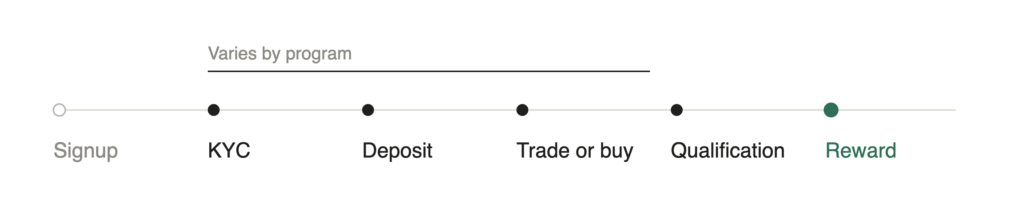
For some programs, registration is only the first step. The referred user may also need to complete KYC, make a deposit, purchase cryptocurrency, trade a certain amount, or buy a product before the reward becomes payable. CEX.IO’s current terms, for example, define separate “Qualifying Actions” for individual referral offers, while Coinbase requires a qualifying crypto purchase for its standard referral program.
Which referral program fits different users?

For active traders – MEXC, Gate.io, and CoinEx reward through referrals based on trading. They are more relevant when your friend wants to trade rather than sign up.
For hardware wallet buyers – Tangem and Trezor focus on product purchases rather than deposits or trades. The friend gets a discount while the referrer gets USDT or credit.
For investors – Bitpanda and Robinhood rely on referrals through activity in an investment account. Bitpanda rewards the referral based on the friend’s investing volume, whereas Robinhood relies on milestone referrals.
For simple fixed rewards – CEX.IO and Uphold have clearer fixed-reward structures in their current terms: CEX.IO’s September promotion provides 25 USDC to each qualifying participant, while Uphold’s current referral terms provide $20 worth of Bitcoin to each participant.
Referral programs vs. Affiliate programs
Referral and affiliate programs can use similar links, but they are not designed for exactly the same purpose.
| Referral Program | Affiliate Program | |
|---|---|---|
| Main audience | Friends and personal contacts | Website and social-media audiences |
| Typical reward | Bonus, discount or crypto | CPA or revenue share |
| Main conversion | Deposit, purchase, investment or trade | Qualified customer activity |
| Promotion | Personal recommendations | Content and audience promotion |
| Recurring commissions | Less common | More common |
| Example | Bitpanda Tell-a-Friend | Bitpanda Affiliate Program |
Bitpanda clearly illustrates this distinction. Its Tell-a-Friend program is intended for personal recommendations. At the same time, users who promote Bitpanda through websites or social channels are directed to its affiliate program, where the company currently advertises up to a 20% revenue share.
What to check before choosing a program
- Qualification – What exactly does the new user need to do?
- Reward type – BTC, USDT, stock, store credit, or fee rebate?
- Minimum amount – Does the user need to deposit, trade, or invest a certain amount?
- Time limit – What is the time frame in which the friend must complete the task?
- Country – Is the offer available for the particular market?
- Sharing conditions – Can the referral link be shared on public platforms?
- Reward limit – Does the referral program have any limits regarding the number of rewards?
FAQ
What is a crypto referral program?
A crypto referral program enables an existing member to refer a new member to join a crypto exchange, wallet, or investment service through a referral link or code. A reward will be made available upon the completion of some qualifying activity by the referred person, such as depositing, trading, investing, buying cryptocurrencies, buying hardware wallets, etc. Rewards may vary by platform. It could be in the form of cryptocurrencies, cash, stocks, discounts, store credits, etc.
How do crypto referral programs work?
All crypto referral programs follow a basic process: an existing client shares a referral link, the newcomer signs up through it, completes the specified actions, and receives a reward once the referral is verified. Different programs have different requirements for the clients. For instance, in CEX.IO’s September 2026 referral program, new users must sign up via the referral link, get verified, and make a $100 fiat deposit. Trezor ties a reward to purchasing a hardware wallet.
Are crypto referral programs different from affiliate programs?
Yes. Referral programs are generally designed for personal recommendations. In contrast, affiliate programs are intended for users who promote a platform to a wider audience through websites, social media, content channels, or other traffic sources. Bitpanda explicitly separates its Tell-a-Friend program from its Affiliate Program and states that users promoting the service through websites or social channels should apply for the affiliate program instead. Our Best Crypto Affiliate Programs guide focuses on this broader audience-based model.
Can I share a crypto referral link publicly?
This depends on each program’s policy. Some platforms allow you only to recommend your referral links to friends rather than use them for public advertising. For instance, according to Trezor, while you can recommend referral links to friends, Trezor does not allow posting referral links on coupon websites, forums, or social networks other than those controlled by the referrer. CEX.IO notes that its general referral program is not for any commercial use, unless stated otherwise in a certain Referral Offer.
Final thoughts
Referral campaigns in the crypto industry include several types of programs, like trade-based bonuses offered by MEXC and Gate. US, or reduced rates for hardware wallets provided by Tangem and Trezor. Other programs, such as Bitpanda, CEX.IO, and Coinbase, offer bonuses based on a specific deposit, investment, or transaction.
The key difference from the affiliate programs listed in Best Crypto Affiliate Programs is that referral programs focus on building a relationship with the new customer.
Make sure to check the campaign details before you refer people. This includes the campaign details, qualifying action, reward type, country restrictions, and referral limits. These details may change over time, even if the platform does not.