

Crypto hedge funds have become a major part of the digital asset market. They use different approaches, from active trading and arbitrage to long-term investments and market-neutral strategies. This guide looks at the leading funds, how they operate, and what makes each one different.
Which strategy actually wins?
In 2026, the market is rewarding very different approaches. Quant and market-neutral funds can make money without simply betting Bitcoin will go up, while venture-focused funds are playing a much longer game.
Long-only → greatest exposure to the markets
Quant → trading on numbers
Market-neutral → profits with little directionality
Multi-strategy → multiple investments in one fund
Venture → first bets, long lock-up periods
The important part is not which strategy sounds best. It’s which one can keep performing when the market changes direction.
Top 10 at a glance
| # | Fund | Type | AUM | HQ | Founded |
|---|---|---|---|---|---|
| 1 | Pantera Capital | Hybrid | $4.8B+ | Menlo Park | 2013 |
| 2 | Polychain Capital | Hedge fund | $2.6B+ | San Francisco | 2016 |
| 3 | Galaxy Digital | Multi-strategy | $2.1B | New York | 2018 |
| 4 | Paradigm | VC/Trading | $8.5B+ | San Francisco | 2018 |
| 5 | a16z Crypto | VC | $7.6B+ | Menlo Park | 2018 |
| 6 | Multicoin Capital | Hybrid | $1.0B+ | Austin | 2017 |
| 7 | Brevan Howard Digital | Multi-strategy | $1.0B+ | London | 2022 |
| 8 | 3iQ | Long-only | $1.5B+ | Toronto | 2012 |
| 9 | Dragonfly Capital | VC | $2.0B+ | San Francisco | 2018 |
| 10 | Wave Digital Assets | Multi-strategy | $1.0B+ | Los Angeles | 2018 |
Pantera Capital

Pantera Capital is one of the oldest and most recognizable crypto investment firms. The company uses a hedge fund model along with venture capital and passive investing, giving it access to both existing cryptos and stage blockchain developments.
Pros
- Long history of operation starting from 2013
- Exposure to both liquid crypto assets and venture investments
- Experienced management team
- Has operated through multiple major market slumps
Cons
- Broad strategy makes it harder to classify as a pure hedge fund
- Venture investments can have long lock-up periods
- High crypto-market exposure can still produce significant drawdowns
Polychain Capital
Polychain Capital focuses heavily on blockchain protocols and digital assets, combining venture-style investments with active crypto strategies. The fund became famous because of its outstanding 2017 performance, but its subsequent drawdown also shows how aggressive early-stage token investing can be.
Pros
- Proven success early on in crypto
- Ability to invest in early blockchain projects and tokens
- High conviction investment strategy
- Big upside potential
Cons
- High risk/volatility
- Significant exposure to token prices and crypto cycles
- Historical performance shows that severe losses can follow large gains
- Less suitable for investors pursuing steady returns
Galaxy Digital

Galaxy Digital takes a wider approach than a traditional crypto hedge fund, combining trading, asset management, investment banking, and other digital-asset businesses. This diversified structure gives it exposure to several parts of the crypto economy rather than relying on a single trading strategy.
Pros
- Cryptocurrency business diversification
- Several sources of income generation
- Strong institutional focus
- Exposure to trading, investing and infrastructure
Cons
- Complex structure compared to a regular hedge fund
- Performance remains closely tied to crypto-market conditions
- Not a pure-play hedge fund
- Broad exposure can make the fundamental risks harder to assess
Paradigm

Paradigm is primarily a crypto venture capital and investment firm, not a conventional liquid hedge fund. It focuses on backing blockchain companies and protocols at an early stage, giving investors access to potentially high-growth projects and also requiring long holding periods and carrying substantial risk.
Pros
- Early access to crypto investments
- Good sector connections
- Long-term investment approach
- Focus on infrastructure and major blockchain protocols
Cons
- Long investment lock-ups
- Venture investments can become illiquid
- High risk of individual investments failing
- The FTX investment demonstrated that even institutional due diligence cannot eliminate investment risk
a16z Crypto
a16z Crypto is Andreessen Horowitz’s crypto-focused investment arm. Unlike a typical hedge fund, it primarily invests in startups, protocols, and blockchain infrastructure with a long-term venture capital approach. Its large funds allow it to build varied portfolios across multiple areas of the crypto ecosystem.
Pros
- Large capital base
- Access to early-stage companies and protocols
- Strong technology and venture expertise
- Highly diversified crypto portfolio
Cons
- Very long investment horizons
- Limited liquidity for investors
- Venture-style risk
- Fund performance can take years to evaluate fully
Multicoin Capital

Multicoin Capital is a high-conviction crypto investment firm that focuses on networks, tokens, and companies building within the digital-asset ecosystem. Its concentrated approach has produced significant gains during bull market cycles, but it has also resulted in substantial losses during major market failures.
Pros
- Strong focus on crypto-native investments
- High-conviction strategy
- Potential for very high returns
- Experienced crypto-focused team
Cons
- Concentrated portfolio risk
- High volatility
- Significant exposure to individual crypto projects
- History of large drawdowns in market crises
Brevan Howard Digital

Brevan Howard Digital is the crypto-focused division of traditional hedge fund manager Brevan Howard. It brings a more trading-oriented, institutional approach to digital assets, with strategies designed to manage risk over various market conditions rather than relying on rising crypto prices.
Pros
- Excellent background in institutional risk management
- Trading orientation
- Less directionally exposed than long-only approaches
- Parent company is highly experienced in traditional markets
Cons
- Strategy can be more complex than simple crypto investing
- Institutional structure may restrict accessibility
- Trading performance may differ considerably among market regimes
- Less centered on long-term venture opportunities
3iQ

3iQ is a Canadian digital-asset investment manager focused on regulated crypto investment products. Compared with offshore hedge funds and venture firms, its approach is more accessible to traditional and institutional investors who prioritize regulatory structure and asset protection.
Pros
- Controlled investment framework
- Friendly towards institutions
- Easier entry into cryptocurrency via investment vehicles
- More conservative structure than many crypto-native funds
Cons
- Possibly lower upside than aggressive crypto strategies
- Less exposure to early-stage projects
- Regulatory requirements can reduce flexibility
- Not a traditional high-risk/high-return crypto hedge fund
Dragonfly Capital

Dragonfly Capital is mostly a cryptocurrency venture capital fund that invests in blockchain protocols and companies at various stages of growth. The fund’s investment approach focuses on spotting promising crypto projects and holding them long-term rather than actively trading tokens.
Pros
- Early access to crypto start-ups and protocols
- Deep knowledge in the cryptocurrency industry
- Long-term investment approach
- Historically willing to invest during bear markets
Cons
- Long lock-up periods
- High startup and project risk
- Investments can be difficult to value
- Returns may take years to materialize
Wave Digital Assets

Wave Digital Assets combines crypto trading, venture investing, and private wealth management. Its SEC-registered structure gives it a different profile from many crypto-native firms that operate through offshore jurisdictions. At the same time, its multi-strategy approach delivers exposure to several parts of the digital-asset market.
Pros
- Registration as an investment adviser firm
- Utilizes both trading and venture investment strategies
- Institution-focused strategy
- More regulatory transparency than many offshore competitors
Cons
- Hybrid multi-strategy makes analysis more challenging
- Exposed to crypto-market volatility
- Venture investments can be illiquid
- Regulatory compliance reduces flexibility compared to offshore companies
Biggest wins vs. biggest disasters, side by side
| Fund | Move | Result |
|---|---|---|
| Pantera Capital | Bought BTC at $65 in 2013 | 130,000%+ lifetime return |
| Polychain Capital | Concentrated early token bets, 2017 | +2,278.8% in one year |
| Brevan Howard Digital | Launched right before Terra/FTX | -5% in 2022 vs. -43% industry average |
| a16z Crypto | Raised $4.5B mid-crash, May 2022 | -40% on the fund that same year |
| Paradigm | Backed FTX’s Series B | $278M written to zero |
| Multicoin Capital | Dodged Luna and 3AC, held Solana and FTX exposure | -91.4% in 2022, still +1,376% since inception |
| Three Arrows Capital | Leveraged Luna position, borrowed everywhere | $10B AUM to liquidation in ~90 days |
Five things that surprise people about this industry
- The word “hedge fund” is doing a lot of work – most of the biggest names (Paradigm, a16z, Dragonfly) are structurally venture funds with 10+ year lock-ups, not liquid traders
- The entire crypto fund industry ($93B) is smaller than a single large traditional hedge fund like Bridgewater or Citadel
- 39% of crypto funds manage under $10M – this is still mostly a small-shop industry, headline names aside
- Dodging one crisis doesn’t protect you from the next: Multicoin avoided Luna and 3AC, then lost 91% of its fund to FTX months later
- Regulatory registration is the exception, not the rule – most funds domicile in the Cayman Islands specifically to avoid it; Wave Digital Assets and 3iQ are the outliers
The crypto fund survival map
| Fund | Core bet | Crash survival | Risk |
|---|---|---|---|
| Pantera | BTC + venture | ★★★★★ | Long-term |
| Brevan Howard Digital | Trading | ★★★★★ | Defensive |
| Polychain | Tokens | ★★★★☆ | High |
| Multicoin | Crypto networks | ★★★☆☆ | High conviction |
| Paradigm | Early-stage crypto | ★★★☆☆ | Long-term |
| Three Arrows | Leveraged crypto | ★☆☆☆☆ | Extreme |
The exciting thing: the largest gains were not necessarily the result of the highest level of risk. In the cryptospace, outlasting the hard years can be more important than thriving during the easy ones.
Six questions before allocating to any fund
- Who custodies the assets – independent of the fund’s own desk, or not?
- How much of the strategy is leveraged vs. spot-exposed?
- Audited NAV via a third-party administrator, or “trust me” reporting?
- What are the redemption periods for – daily, monthly, or lock-up as in a VC fund?
- Has the strategy survived a full drawdown cycle, not just a bull run?
- Is “AUM” a real trading balance, or undeployed committed capital dressed up as one?
What makes a crypto hedge fund “the best”?
A fund can have spectacular returns but terrible drawdowns. Another can generate smaller gains while staying almost completely detached from Bitcoin’s price swings.
For 2026, the stronger comparison is:
- Performance – How much did the fund actually make?
- Risk – How painful were the losses along the way?
- Consistency – Did the strategy work outside a bull market?
- Liquidity – How easily can investors get their capital back?
Where сrypto funds actually make money
Directional bets – BTC, ETH and major tokens
Market making – Earning from spreads and liquidity
Arbitrage – Taking advantage of price differences between markets
Venture – Funding ventures before tokens/products launch
Infrastructure – Exchange and custodian services, wallet solutions, and blockchain infrastructure investment
Yield strategies – Staking, lending, and DeFi (Decentralized Finance) products
How to evaluate a crypto fund in 10 minutes
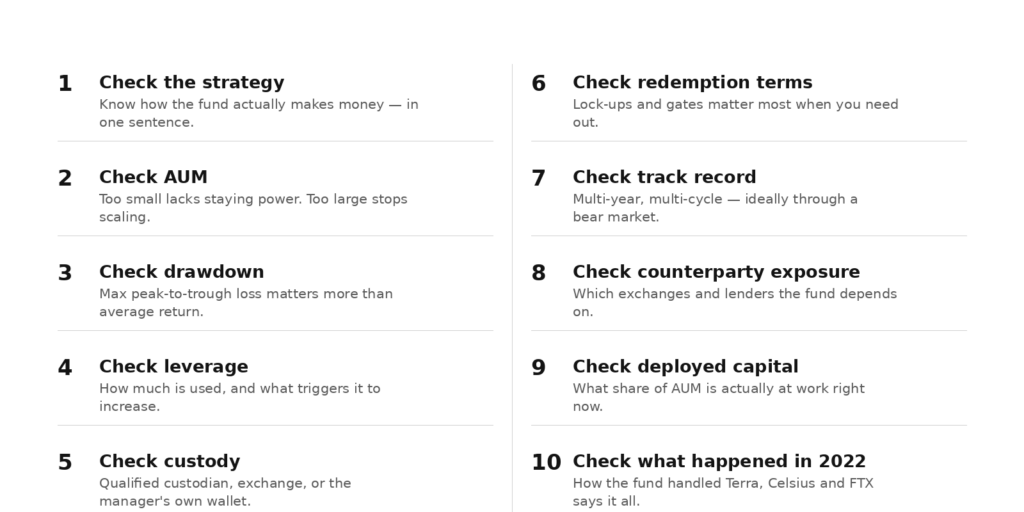
1. Check the strategy
Understand clearly how the fund generates profits – market-neutral, directional, yield farming, or arbitrage. If you cannot put it in one sentence, the managers cannot either.
2. Check AUM
Being small-sized implies insufficient resources for operations, whereas being large-sized implies too many to implement the strategy.
3. Check drawdown
Consider the maximum drawdown and average return rate in this case. A fund that generated a 40% return on investment with a 60% drawdown during this period can show a lot about your risk tolerance.
4. Check leverage
Inquire about the amount of leverage and when and under what conditions it is raised. Leverage can make an otherwise small drawdown a mortal blow to the fund.
5. Check custody
Whose money is going to be in whose hands? The custodian’s? The exchange’s? The manager’s? Manager self-custody is your weak point.
6. Check redemption terms
These terms include lock-up periods, gates, and notice periods, and you ought to be familiar with them before you try to withdraw from the fund.
7. Check track record
The relevant track record should span several years and cycles, preferably including at least one bear market. A good 2023-2024 track record doesn’t mean anything.
8. Check counterparty exposure
Does the fund have any exposure to exchanges, lenders, or prime brokers? Overexposure to any one counterparty contributed to all the 2022 failures.
9. Check whether AUM is deployed
Is the fund sitting in a lot of cash or stablecoins while promoting an active investment strategy? Find out how much capital is currently being utilized.
10. Check what happened during 2022
The single best filter. How the fund handled Terra, Celsius, and FTX tells you more about risk management than any pitch deck ever will.
Conclusion
Crypto funds certainly don’t all play by the same rules. Some seek high returns, some focus on trading, and some don’t mind waiting years to see profits from their investments. Their approach to handling risk distinguishes them.