
Most “best crypto games” lists rank whatever pays the biggest signup bonus, not whatever’s actually fun. These ten made the cut because they’d still hold up if the token crashed to zero tomorrow.
Blockchain gaming finally stopped being embarrassing
For several years, the term “crypto game” was associated with a Telegram bot that included a battles animation: tap, earn a token, and have it crash in six months. The era isn’t dead yet, but there are already enough games in 2026 that you could give to a crypto-illiterate person and they wouldn’t realize it right away.
The fundamental idea behind the games remains the same, however. If it were a regular game, you would lose that rare skin because its rights belong to the publisher, who can close the servers whenever they like. In the new games, the rights remain yours, and you can sell or transfer the rare skin from your own wallet. Almost all of them operate with play-to-earn principles, awarding players tokens or NFTs for completing quests or owning certain items, and a few of them even allow token holders to vote on the future of the game through a DAO.
How the scoring works
Five factors, weighted so gameplay quality outweighs token hype almost 2:1.
| Criterion | Weight | What it’s actually checking |
|---|---|---|
| Gameplay | 30% | Does it hold up if you strip the earning angle out entirely? |
| Accessibility | 20% | Can someone with zero crypto background get in without a 40-minute wallet tutorial? |
| Rewards | 20% | Is the token economy built to last, or is it running on emissions and hope? |
| Security | 15% | Public team, audited contracts, honest risk disclosure |
| Originality | 15% | Does the blockchain part actually do something, or is it just a sticker on the box? |
The top 10

The range here is wider than usual: a AAA battle royale at the top, a seven-year-old RPG holding its ground at #2, and a slow-paced Animal Crossing clone near the bottom that’s still worth a look if grinding isn’t your thing.
1. Off the Grid

Battle Royale/Extraction Shooter · Gunzilla Games (the studio behind Warface)
A cyberpunk battle royale that really competes with Fortnite and PUBG on production value, which is still rare in this corner of gaming. It’s free, and the Web3 layer sits next to the game instead of running through the middle of it – open HEX loot boxes, trade what drops on the marketplace. You could play a dozen matches and forget crypto is even involved.
- Earn via: NFT looting, opening HEX boxes
- Chain/token: Avalanche (GUNZ subnet) · GUN
- Entry: Free up to ~$50 for Web3 bonuses
- Status: Early access
Community feedback on Off the Grid is mixed. In an August 2026 Reddit discussion, players raised questions about matchmaking, bot activity and the game’s future. These concerns highlight an important distinction: strong gameplay ideas do not automatically guarantee an active player base.
Pros
- Graphics & production quality among the best in blockchain games
- Free entry makes it easy to try
- Crypto features do not dominate the core gameplay
- NFT items can be traded between players
- Familiar battle royale and extraction mechanics
Cons
- Still in early access, so the game can change significantly
- Web3 features may feel unnecessary to players who only want a shooter
- The value of tradable items depends on marketplace demand
- Requires further setup for players who want to use the blockchain features
2. Axie Infinity
RPG · Sky Mavis
The old guard – live since 2018 and still clearing over $3M in monthly transaction volume, a genuinely long shelf life for this space. You collect, breed, and battle axolotl-like creatures called Axies. Back in November 2021, a plot of virtual land here sold for $2.3 million; the economy has cooled since then, but the core loop and the community around it are still very much alive.
- Earn via: NFT transactions, PvP earnings in SLP and AXS
- Chain/token: Ronin/Ethereum · AXS, SLP
- Entry: Free, less than $50 for starting team
- Status: Live
Pros
- Long operating history and established community
- Multiple ways to interact with the game’s economy
- Free-to-start options are available
- Collecting and battling provide a clear gameplay loop
- Large ecosystem built around Ronin
Cons
- The earning model is much less attractive than during its peak
- Token prices can heavily affect the economics
- New players may need time to understand the ecosystem
- Competition could create difficulty for earning money
- NFT ownership does not ensure profitability on resale
Recent Reddit discussions offer a more grounded view of Axie Infinity’s earning potential. In an October 2026 thread, one player reported earning around $3-4 in bAXS per week through the Bounty Board. This is an individual experience, not a guaranteed return, and actual rewards depend on player activity and token prices.
3. Shrapnel

Extraction Shooter/FPS · Neon Machine
Developed by those who grew up on Halo, Call of Duty, and Star Wars games, and it’s obvious the game has been well thought out. Imagine Escape from Tarkov mixed with an environment in which player-made maps, modes, and cosmetics are all tokenized and available for trade.
- Earn via: trading and sales of player content as NFTs
- Chain/token: Avalanche, SHRAP
- Entry: $50–200
- Status: Early access
Pros
- Good FPS and extraction-shooter framework
- Player-generated content gives it more long-term potential
- Blockchain has a clear role in ownership and trading
- Designed with competitive players in mind
- More substantial gameplay than simple play-to-earn titles
Cons
- Still developing and not as polished as established AAA shooters
- Relatively high potential entry cost for some players
- Smaller player base than mainstream FPS games
- Web3 economy adds complexity
- Future success depends heavily on continued development
4. Gods Unchained

Collectible Card Game · Immutable
If you have ever played Hearthstone or Magic: The Gathering, you should be familiar with this cycle. The difference is that all cards are actual NFTs, rather than assets that exist only within a single application. You earn GODS tokens when you progress through ranked matches and achieve certain milestones with your collection.
Players are already comparing cards from the latest Reckoning set and discussing their competitive potential. Community-made tier lists offer another perspective on the evolving meta and the decisions players face when building their decks.
- Earn via: card NFT trading, ranked GODS rewards
- Chain/token: Immutable X · GODS
- Entry: Free
- Status: Live
Pros
- Free to start
- Familiar gameplay for card-game fans
- Players can actually own and trade their cards
- Competitive gameplay gives rewards a skill-based element
- Easy entry point into blockchain gaming
Cons
- Card collecting can become expensive for competitive players
- NFT prices depend on demand
- Learning the card pool can take considerable time
- Rewards are not guaranteed income
- Players who dislike card games may find little appeal
5. Big Time
Action RPG · Big Time Studios
A time-travel hack-and-slash that plays first and monetizes a distant second. The NFTs are mostly cosmetic – no pay-to-win mechanics baked in – so this feels closer to a classic co-op RPG that happens to have a marketplace than a crypto product wearing a game as a costume.
- Earn via: trading cosmetic NFTs
- Chain/token: Ethereum · BIGTIME
- Entry: Free
- Status: Live
Big Time’s latest Halloween event adds daily challenges and extra rewards, giving players another reason to jump back into the game.
🏆 Big Time Rewards Event — Week 7 is HERE! 🎉 The seventh week of the Big Time Rewards Event has officially begun! ⏳ 📷 It’s Halloween week, Time Travelers! Get ready to hunt down and slay Void mobs! 📷 🎯 Your challenges for this week: 📅 Monday — Equip a Belt equipment slot. 📅 Tuesday — Kill a Void Crawler. 📅 Wednesday — Kill a Void Snare. 📅 Thursday — Kill a Void Slasher. 📅 Friday — Kill a Void Lich. 📅 Saturday — Kill a Void Lich Summoner. 📅 Sunday — Open a Legendary Rarity Chest. ⚠️ Dungeon Chests only. Objective Chests, such as Boss Chests and Quest Chests, do not count. 🔥 The more challenges you complete, the better your chances of winning! 🏆 🚨 The event schedule follows UTC time, from 00:00 to 23:59. 📢 Stay tuned! Week 6 winners will be announced after a brief audit period. 📷 Good luck, Time Travelers! May your Halloween hunt be rewarding! 📷
— Big Time (@playbigtime) October 26, 2026
Pros
- Free-to-play
- Familiar action RPG-style gameplay
- NFTs are mostly cosmetic
- No apparent pay-to-win strategy
- Blockchain-related aspects can stay optional
Cons
- Earning opportunities are relatively limited
- NFT values depend on marketplace demand
- The game competes with a huge traditional RPG market
- Players interested primarily in crypto may find the economy less compelling
- Long-term value depends on maintaining an active community
6. The Sandbox
Metaverse/Builder · Pixowl (Animoca Brands)
Less a game, more a creation tool – Minecraft meets Roblox, with land as NFTs and no-code editors (VoxEdit, Game Maker) for building your own experiences. Partnerships with Atari and Snoop Dogg gave it early mainstream visibility. The draw here is building and monetizing something of your own, not grinding a combat loop.
- Earn via: monetizing your creations, land appreciation
- Chain/token: Ethereum · SAND
- Entry: Under $50 to start earning
- Status: Live
Pros
- Strong focus on user-generated content
- Players can create rather than consume content
- Land and digital resources are tradable
- Established brand and ecosystem
- Good option for creative players
Cons
- Not suitable if you need conventional games
- Content creation takes time and effort to learn
- Property can be costly in good locations
- Asset values can be highly speculative
- Monetization depends on attracting other users
The Sandbox is built around user-created experiences, not just playing through content made by others. Its appeal comes from giving creators room to experiment with their own game ideas and build worlds other players can explore.
The Beta Creator Game Jam winners are in, judged by @majornelson 🏆 1st Place goes to Omniscient by @lifemademe 🥇 In Omniscient, you play as an AI built to help. You listen, observe, connect and slowly start asking questions of your own. Play it 👉 https://t.co/fZQCNh5ZPJ https://t.co/4tfx4WpC4T
— The Sandbox (@TheSandboxGame) September 21, 2026
7. Pudgy Penguins
Party Game/Battle Royale · Mythical Games
Started life as an NFT collection – now past $746M in all-time trading volume – before growing into a full brand with Pudgy Party, a free Fall Guys-style mobile game. Worth being upfront about: there’s no earning mechanic inside the game itself. This is brand marketing, just unusually charming brand marketing.
- Earn via: trading the underlying NFT collection (not inside the game)
- Chain/token: Ethereum · PENGU
- Entry: Free
- Status: Live
Pudgy Party passed 500,000 downloads on the App Store and Google Play within two weeks of its August 2025 launch, without offering players any way to earn inside the game.
Pudgy Party has officially passed 500,000 downloads on the Apple App Store and Google Play Store. Billions will party 🐧 https://t.co/vqhdjI1whp
— Pudgy Penguins (@pudgypenguins) September 11, 2025
Pros
- Very accessible for casual players
- Free-to-play experience
- Recognizable IP with an established community
- Simple gameplay makes it suitable for newcomers
- Does not require players to focus on crypto to enjoy the game
Cons
- There is no major earning mechanic inside the game
- NFT ownership is separate from the actual gameplay
- The value of the collection remains highly market-dependent
- Less depth than dedicated competitive games
- Players uninterested in the brand may have little reason to engage
8. My Neighbor Alice
Cozy Multiplayer Builder · Antler Interactive
A world inspired by Animal Crossing that revolves around teamwork rather than competition. Customizable avatars, island decoration, item creation, and sales. Fully on-chain game with ALICE governance and staking. Purposefully paced to be slow to play, which can be the very thing that makes it special or not, depending on your priorities.
- Earn via: NFT trading, rewards
- Chain/token: Chromia · ALICE
- Entry: Free, less than $50
- Status: Live
The entry barrier is lower than it used to be. Since the Chapter One update in June 2025, the game runs in the browser and creates a wallet automatically, so newcomers can start playing without any crypto setup.
Chapter One is live. The new adventure begins NOW. 🌸 🎮 Start playing with one click: https://t.co/BkfVeQZRex After years of building, the gates of Lummelunda are open for a brand-new journey. 💚 Today marks the official release of My Neighbor Alice – Chapter One: A New Adventure, a bold step into the future of blockchain gaming. And this isn’t just a launch — it’s a transformation: 👉 Playable on Browser – One click to dive in. No downloads. Stunning graphics. 👉 Frictionless account creation, no wallet needed – We will create it for you. 👉 New Island, new region, and brand new @pudgypenguins Hub. 👉 Companion feature unlocked – Get your Pudgy Penguin into the game. 👉 Land Sharing – Create, collaborate, and share. Build the world together. 👉 Moxie System – A new core mechanic that powers how you gain XP and progress in the game. From today, anyone can enter Alice’s world. Whether you’re a seasoned builder or stepping onto the island for the first time, this is your moment. Your land. Your adventure. Your story. 🌸 Play Now Chapter One: A New Adventure: https://t.co/BkfVeQZRex
— Alice (@MyNeighborAlice) June 17, 2025
Pros
- Fun, relaxed option as opposed to competitive blockchain games
- Free game to play
- Focuses more on creativity and customization
- NFT ownership has a clear role in the ecosystem
- Suitable for players who enjoy social and cozy games
Cons
- Slow pace will not appeal to everyone
- Smaller audience than mainstream cozy games
- Earning opportunities depend on the ecosystem’s activity
- Blockchain mechanics can make the experience more complicated
- NFT prices can be volatile
9. EVE Frontier

Survival MMO/Sandbox · CCP Games
Located in the world of EVE Online, but designed for survival and crafting on a small scale rather than large-scale war. In this case, the blockchain ensures asset ownership. It is quite complex, and the learning curve is steep – it is for those who have experience with the complexity of EVE.
- Earn via: crafting, selling, and trading NFTs
- Chain/token: Ethereum · not yet disclosed
- Entry: Free; $50-200 to earn meaningfully
- Status: In development
EVE Frontier’s ambitious sandbox concept has attracted players, but its current controls and interface remain a point of criticism. In an August 2026 Reddit discussion, one player described the controls as clunky and the interface as difficult to use. For a game still in development, these issues are worth considering alongside its long-term potential.
Pros
- Professional game developer is the creator
- Deep and complex gameplay systems
- Strong focus on player-driven economies
- Blockchain can support ownership and programmable assets
- Appeals to players who enjoy sandbox games
Cons
- Steep learning curve
- Still in development
- Can intimidate novices
- Real commitment can demand a lot of time or money
- Its intricacy could reduce its approachability to mainstream people
10. Decentraland

Metaverse/Virtual World · Decentraland Foundation
One of the first blockchain metaverses: land as NFTs, user-built spaces, and event hosting. By 2026, it functions more as a venue for online events and exhibitions than a game you’d sit down and “play” in the traditional sense. Graphics feel dated next to newer entries on this list, but the land economy is still real.
- Earn via: LAND sales/rentals, event hosting, NFT deals
- Chain/token: Ethereum · MANA
- Entry: $50–200
- Status: Live
Pros
- Well-proven blockchain-based game/metaverse platform
- Ownership and trading of virtual land available
- Creation of custom experiences and events possible
- Multiple ways to monetize digital domains
- Large amount of existing content and history
Cons
- Graphics feel dated compared with newer games
- Gameplay is less compelling for traditional gamers
- LAND can require a significant investment
- Virtual real estate is highly speculative
- Activity and demand can vary considerably over time
Cost in vs. reward out
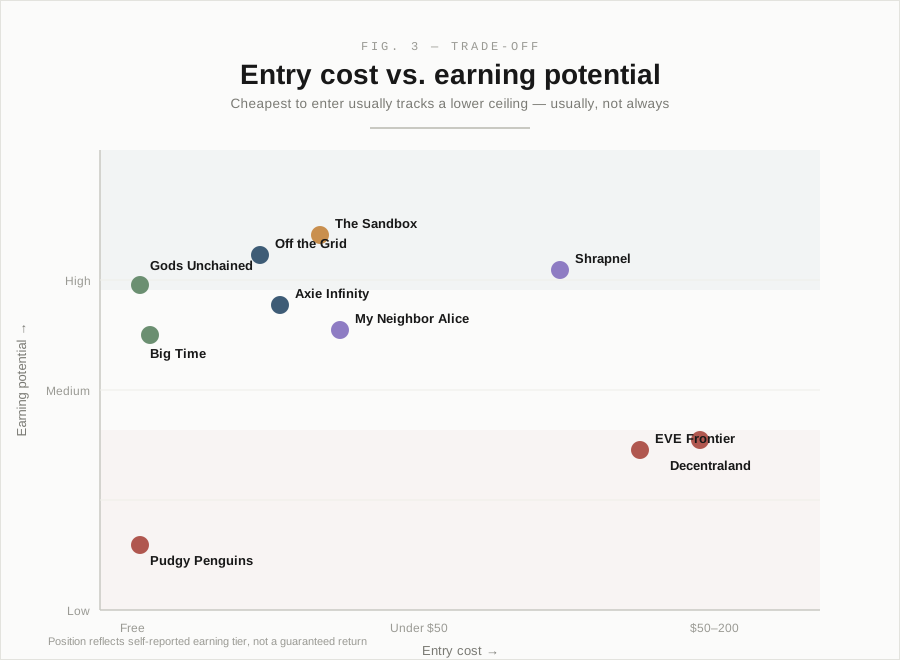
Cheap doesn’t mean bad, and expensive doesn’t necessarily mean ROI. Games such as Gods Unchained and Big Time are free to play but earn their place among the “medium” earners through skills rather than finances. On the other hand, Decentraland and EVE Frontier sit at opposite ends of the spectrum.
Free vs. paid – which lane to start in

Start free if you’re new to Web3 and want to learn wallets, NFTs, and marketplaces without risking anything. Gods Unchained, Big Time, and Pudgy Penguins all work for this. Rewards are smaller and competition for them is stiff, but the downside is close to zero.
For paying users who already understand the risk, go for people seeking more systems or hoping for real returns. Games like Axie Infinity, The Sandbox, and Decentraland pay off initial investments with richer economies – but all this is true only as long as the community remains active.
The honest pros and cons
What’s genuinely good:
- True ownership of in-game objects through NFTs
- A chance to make money while having fun instead of grinding in vain
- Economies built on the blockchain by design
- A few games where you actually get a vote on direction, via DAOs
What to keep in the back of your mind:
- Token prices move fast and hard, in both directions
- The space still has no shortage of scams and abandoned projects
- One wallet slip-up could lead to monetary loss, and there would be no undoing it
- Regulation around crypto gaming is still being written in real time
Six habits before you connect a wallet
- Always keep your secret phrase and keys secret; no support agent will ever ask you about them.
- Download wallets such as MetaMask and Trust Wallet from their official websites.
- Use a different wallet for gaming than for any assets you may consider for savings.
- Make a test transaction before investing any money.
- Only use known games that have an active community – “guaranteed profit” is always suspicious.
- Check gas fees and balances before you confirm anything.
One more habit this autumn made obvious: revoke old approvals. In September 2026, attackers used permissions people had granted to Magic Eden’s EVM marketplace back in 2024, long after most had forgotten about them. If you’ve ever traded NFTs, it’s worth checking which contracts can still move your assets.
We are sharing an interim update regarding an exploit identified with @limitbreak Payment Processor V2, a NFT trading protocol maintained by the company Limit Break and which Magic Eden adopted to settle trades on EVM in 2024. Magic Eden stopped using Payment Processor V2 in Oct 2024 and ceased our EVM marketplace altogether in Q1 2026. No live Magic Eden listings were impacted in this exploit. We will provide more updates as we investigate the impact further. We are also contacting Limit Break as they are the owner & maintainer of the protocol to see what other mitigations can be done, including progress on pausing transfers on the protocol. Thank you to @0xQuit for the whitehat rescue and for bringing this to our collective attention: https://t.co/vXwUS5laJE Why are ME listings being shown to be involved? NFTs listed on ME EVM from approx Feb 2024 to Oct 2024 could be impacted by this issue with the Limit Break Payment Processor v2 contract. Any listings on ME EVM after Oct 2024 should not be impacted here. We are still further refining our investigation and will provide more updates here. In the meantime, if you listed or traded NFTs on Magic Eden’s EVM marketplace before we shut it down, revoke this contract: Limit Break: Payment Processor (V2) 0x9A1D00bEd7CD04BCDA516d721A596eb22Aac6834 Go through our instructions here: https://t.co/34d0BQ6rh9 Ethereum → filter that address → revoke every NFT “approved for all” row Repeat for the following chains: Polygon Base See also 0xQuit’s tweet on revocation for further reference also: https://t.co/9guRvUZK1e NOTE: Revoking does not return tokens that already moved. Again, we will keep the community updated as we investigate further.
— Magic Eden 🪄 (@MagicEden) September 25, 2026
FAQ
Do I need to buy anything to start?
Nope. Off the Grid, Gods Unchained, Big Time, and Pudgy Penguins all have free-to-play versions that let you play the whole game, including wallet functionality, for no cost at all – completing quests, earning free tier rewards, and feeling out the economy without spending a dime. Start dropping cash after you’ve played and enjoyed the game, rather than being directed by a tutorial to buy a starter pack.
Which one’s easiest for a total beginner?
Gods Unchained. It’s a card game most people already half-know from Hearthstone or Magic, so there’s no new genre to learn on top of the crypto layer. Wallet setup takes a few minutes, matches are free to play from turn one, and nothing in the interface pressures you to buy cards before you’ve even seen how a game plays out.
Can this actually replace income?
Yes, but only for a small number of people – those who treat it as part-time work, play it regularly, and joined a popular game from its start. For most other people, earning will be more like spare change than regular pay, which stops as soon as the coin loses popularity or the community starts to shrink. Think of any money you earn as additional cash to what you would already be playing the game for, not as income.
What’s the biggest rookie mistake?
Investing in the game’s assets before actually trying it – buying some NFTs, some land, or a package of tokens because of all the buzz about the game, and later realizing that you do not like playing it. Play it for free and decide if it is something you want to play – only then invest.
Is my money safe in these games?
As safe as any crypto holding, which means: safer than a random new token, but never guaranteed. An audited smart contract and an active, long-running community are good signs – they imply fewer obvious ways for the project to fail or rug-pull quietly. None of that removes the underlying risk that token prices swing hard, or that a wallet mistake on your part can lose funds with no way to reverse it.
Bottom line
Looking for strategy rather than grinding? Axie Infinity. Looking for an AAA first-person shooter game with cryptos in the background? Off the Grid. Looking to develop something of your own? The Sandbox. Free to start and learn the gameplay without having anything to lose; move forward only when you know precisely what is at stake.