

The decision about where to license a crypto business is far more complex than it might seem. There are differences not only in fees, waiting periods, and what qualifies as a legitimate license, but also in how marketing differs from regulatory processes.
This guide lays out what each jurisdiction actually involves – and, because a license is only as good as the person who filed it, who to bring in once you’ve picked one. That second half is covered in full in our companion piece, Best Crypto Lawyers & Blockchain Law Firms, which this guide leans on throughout.
Two decisions, not one
Founders tend to treat “where do I register” and “who do I hire” as separate questions, asked months apart. They’re really one decision made in two steps.
The lawyer guide linked above opens with four questions worth asking about counsel: can they move fast enough to matter, do they know the regulator personally, will they still take your call once you’re no longer a fund, and is the bill actually proportional to the problem? Those same four questions work almost unchanged for picking a jurisdiction – a regulator nobody in your firm has a relationship with is exactly as risky as a lawyer nobody at the regulator has heard of.
What “crypto-friendly” actually means
A jurisdiction is worth considering if it has four things in place:
- A written, supervised licensing regime – not just informal tolerance.
- Banking access regulators and banks both accept – a license no bank will honor doesn’t do much.
- Tax treatment that’s predictable and doesn’t punish holding crypto on a balance sheet.
- A recognition or passporting route into a market you actually need.
Best jurisdiction by business type

The top 10, ranked
1. UAE

Regulator: VARA
- Real banking, real regulator, real prestige
- The speed everyone quotes is free-zone company setup, not the actual license
- The genuine VARA approval is a marathon dressed up as a sprint
2. Switzerland

Regulator: FINMA/SRO
- Two countries wearing one flag: a fast, affordable path and a slow, expensive one
- The affordable route works for most exchanges and brokers
- Custody, deposits, or trading venues get pushed onto the slow, six-figure path instead
3. Singapore

Regulator: MAS
- Getting turned down here is practically more frequent than getting accepted
- It’s the lack that makes the license worth having
- A license here signals you survived something hard, not just that you paid a fee
4. European Union (MiCA)
Regulator: ESMA/national regulators
- One filing, and the whole bloc opens up
- The old national shortcuts are closing right now
- The “easy” version of this path is quietly disappearing
5. Cayman Islands
Regulator: CIMA
- Zero taxation appears to be the whole truth
- Infrastructure in this case is not free
- You’re paying for the reputation, not just the paperwork
6. Estonia

Regulator: Estonian FSA
- Used to be the wild, cheap EU entry point everyone rushed into
- Got a serious regulatory overhaul a few years back
- The old “budget option” reputation hasn’t caught up with the pricier reality
7. Georgia
Regulator: VASP registry
- Gives you a license faster than your coffee can get cold
- No hassle, no reporting
- Understand what you are trading off for that quickness – depth is not included
8. Hong Kong

Regulator: SFC
- A regulator that actually enforces its own rules
- That credibility comes at institutional prices and institutional patience
- This is where you proceed once you’ve outgrown “startup,” not before
9. El Salvador

Regulator: CNAD
- The entry fee is almost suspiciously low
- The wait to actually get through the door is not
- Once you’re in, the tax treatment makes the wait worth it
10. Seychelles/St. Vincent
Regulator: FSA-equivalent registries
- The lightest touch on this whole list
- The license itself is barely a hurdle
- The real test comes after – convincing an actual bank to take you seriously
The jurisdictions, and what they actually cost
| Jurisdiction | Regulator | Cost | Timeline | Tax |
|---|---|---|---|---|
| UAE | VARA | AED 40K-100K application fee, plus activity-based capital from ~$136K | 6-12 months | 9% corporate/0% personal CGT in free zones |
| Switzerland | FINMA/SRO | CHF 15K-25K (SRO route) or CHF 100K-250K (direct FINMA) | 2-3 months (SRO) or 6-12 months (FINMA direct) | Moderate, cantonal |
| Singapore | MAS | $40K-100K setup, plus SGD 250K minimum capital | 6-12 months | No capital gains tax |
| EU (MiCA) | ESMA/national regulators | Varies by member state | Months; national windows closing | Standard EU corporate tax |
| Cayman Islands | CIMA | ~$6,100 government fee, ~$40K-120K all-in | 4-8 months | 0% direct taxation |
| Estonia | Estonian FSA | $75K-200K+ first-year cost, €100K-250K minimum capital (by service type) | 3-6 months | EU standard |
| Georgia | VASP registry | ~$17K-32K year one | Under 6 weeks | Minimal reporting |
| Hong Kong | SFC | HKD 5M+ capital (~$640K+), setup costs into six figures | 14-22 months (direct route) | Standard Hong Kong corporate tax |
| El Salvador | CNAD | $5,475 government fee, $2,000 minimum capital | 3-6 months | 0% corporate tax on licensed activity |
| Seychelles/St. Vincent | FSA-equivalent registries | Lowest entry cost on this list | Weeks | Minimal, but weak banking access |
Five things people get wrong about this list
- “Dubai takes 4-8 weeks.” A real VARA license takes 6-12 months. It takes weeks to register a free-zone company – a different document with a different regulator behind it.
- “Switzerland costs CHF 100K.” Depending on how you’re planning to get there. SRO Membership, which is the approach most exchanges and brokers take, will cost you CHF 15K–25K and take about two months. FINMA Authorization, required for custody, deposits, or trading venues, is a time-consuming, six-figure process.
- “Estonia is the cheap MiCA entry point.” Yes, but until 2022. Since then, the minimum capital amount for Estonia has been raised to €250,000 and the processing time to 6-9 months. The status of a “cheaper EU jurisdiction” hasn’t changed yet.
- “There’s a Panama crypto license.” Not currently. What gets sold as one is a fast company registration with a genuinely good tax setup – worth having, but not the same regulatory instrument as a licensed VASP regime in Cayman or El Salvador.
- “El Salvador is instant.” The $5,475 fee is real and modest. The CNAD review isn’t instant, though – plan on 3-6 months.
When jurisdiction and counsel collide: the Wormhole case
The clearest illustration of why these two decisions can’t really be separated is the 2022 Wormhole hack – a $320M theft that played out across at least three legal systems at once.
The attacker moved funds through a DeFi protocol built on English law. Kobre & Kim didn’t wait for a slow, single-jurisdiction process – they went straight to an English court for an injunction against the protocol itself, freezing roughly 90% of the funds mid-transaction, followed by a supporting decision out of New York. Total recovery ran past $400M. None of that works if the firm knows only one jurisdiction’s courts, and none of it works if the underlying protocol sits somewhere with no functioning legal system in which to seek an injunction.
This is why there is so much truth to be found in viewing the two concepts together, because once you don’t have any supportive legal framework, “having a lawyer” makes absolutely no sense anymore.
Which license do you actually need?
An exchange, custodian, broker, wallet service, payment company, and token issuer will be subject to vastly varied regulatory obligations. Some functions will have to be authorized, some registered, or even exempted. First, define the function before you consider comparing the countries.
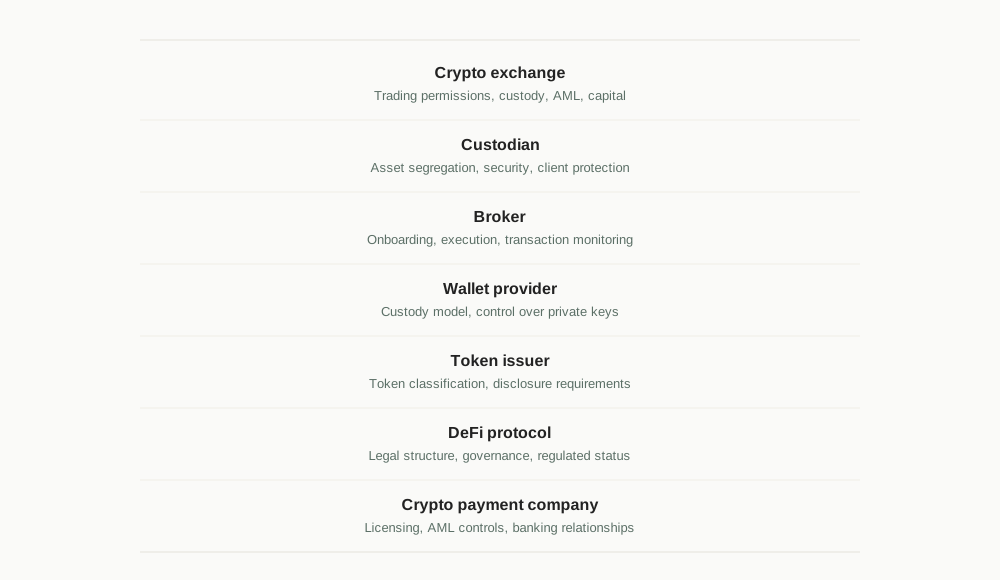
It is selecting the country before considering the business model. It should be the opposite. Define the activity and determine the regulatory perimeter before selecting the jurisdiction.
Match the move to the lawyer
| You’re doing this… | You need… | Why |
|---|---|---|
| A token launch that needs to be SEC-safe | Perkins Coie | On the blockchain beat since 2012; helped define the SEC’s “Qualified Crypto Asset” standard |
| A Swiss or EU foundation/DAO | MME Legal | Based in Zug, authored the Swiss Foundation playbook; Chambers Band 1 every year |
| A MiCA license covering the whole EU | DLA Piper | Technical Partner of the MiCA Crypto Alliance; office network built for multi-market rollouts |
| Licensing across 10+ countries at once | Baker McKenzie | 22 firm rankings and 26 lawyer rankings in Chambers FinTech, Band 1 across four continents |
| An institutional raise right after relocating | Latham & Watkins | Advised Aztec Network’s $60.8M token offering; built for institutional deals, not litigation |
| An emergency, mid-move asset recovery | Kobre & Kim | Froze ~90% of the Wormhole hack’s $320M via English court injunction, filed within days |
| A regulator that already opened a file | Skadden | Eight Chambers FinTech rankings; 1,700+ attorneys – the pick once the SEC/CFTC is already involved |
| An insurer refusing a crypto-theft claim | Anderson Kill | Represents policyholders, not insurers, in crypto-related coverage disputes |
| Years of messy personal crypto tax | Gordon Law Group | Crypto tax lawyers and CPAs since 2014 – still answers the phone under six figures in exposure |
Full firm profiles, pricing signals, and case histories are in the best crypto lawyers guide.
The jurisdiction lifecycle
Most founders think about choosing a jurisdiction as a one-time decision. In reality, the relationship with a jurisdiction changes as the company grows.
Stage 1 – Launch
You need a structure that is simple enough to get the business moving.
Stage 2 – Growth
More employees, customers and transactions bring new regulatory and reporting requirements.
Stage 3 – Institutional
Banks, funds and larger counterparties start looking much more closely at the legal structure.
Stage 4 – Expansion
The company needs to enter new markets without having to rebuild everything from scratch.
Stage 5 – Exit
The structure needs to be understandable to a buyer, investor, or acquiring company.
Crypto jurisdictions aren’t only about crypto
A country’s wider financial network can matter more than its crypto rules. Look beyond the crypto regulator and check:
Banks → Payment processors → Auditors → Accountants → Corporate services → Insurance → Legal services → Financial institutions
A country with a good crypto regulatory environment but poor financial infrastructure may cause more complications compared to a country that costs a bit more but has well-developed financial infrastructure.
Before you commit – a quick gut check
- A law firm or corporate services provider not offering you a flat-fee quote up front? Take a minute to consider that one.
- Someone making a guaranteed approval date? No honest regulator or advisor makes that promise – every timeline above is a range for a reason.
- A “license” that turns out to be a company registration? Ask exactly which regulator issued it and under which law. Panama is the clearest current example of that gap.
- Match the lawyer’s size to the job. A single-country VASP registration in Georgia doesn’t need an AmLaw-50 retainer. A ten-country rollout across MiCA and VARA probably does.
Bottom line
No one-size-fits-all jurisdiction exists in cryptocurrency, just as there is no one-size-fits-all cryptocurrency attorney; everything depends on your actual project. Shiny numbers are unlikely to withstand scrutiny by the regulator that issued them. Switzerland and Singapore are less flexible but earn you credibility. The UAE and the Cayman Islands are more expensive but have actual infrastructure. Panama and El Salvador offer you speed and simplicity, but at the expense of regulation depth. Having selected your jurisdiction based on numbers that you have verified, hire an attorney who knows the regulator personally – check the full ranking of lawyers here.