
Crypto hedge funds have become a major part of the digital asset market. They use different approaches, from active trading and arbitrage to long-term investments and market-neutral strategies. This guide looks at the leading funds, how they operate, and what makes each one different.
Which strategy actually wins?
In 2026, the market is rewarding very different approaches. Quant and market-neutral funds can make money without simply betting on Bitcoin going up, while venture-focused funds are playing a much longer game.
Long-only → greatest exposure to the markets
Quant → trading on numbers
Market-neutral → profits with little directionality
Multi-strategy → multiple investments in one fund
Venture → first bets, long lock-up periods
The important part is not which strategy sounds best. It’s which one can keep performing when the market changes direction.
Top 10 at a glance
| # | Fund | Type | AUM | HQ | Founded |
|---|---|---|---|---|---|
| 1 | Pantera Capital | Hybrid | $4.8B+ | Menlo Park | 2013 |
| 2 | Polychain Capital | Hedge fund | $2.6B+ | San Francisco | 2016 |
| 3 | Galaxy Digital | Multi-strategy | $2.1B | New York | 2018 |
| 4 | Paradigm | VC/Trading | $8.5B+ | San Francisco | 2018 |
| 5 | a16z Crypto | VC | $7.6B+ | Menlo Park | 2018 |
| 6 | Multicoin Capital | Hybrid | $1.0B+ | Austin | 2017 |
| 7 | Brevan Howard Digital | Multi-strategy | $1.0B+ | London | 2022 |
| 8 | 3iQ | Long-only | $1.5B+ | Toronto | 2012 |
| 9 | Dragonfly Capital | VC | $2.0B+ | San Francisco | 2018 |
| 10 | Wave Digital Assets | Multi-strategy | $1.0B+ | Los Angeles | 2018 |
Pantera Capital

- Bought its first Bitcoin in July 2013 at $65-74
- That position is now up over 1,000x – 130,000%+ net of fees, per founder Dan Morehead’s own investor letters
- Founded by ex-Goldman trader Morehead, backed at launch by Pete Briger and Mike Novogratz
- Survived the Mt. Gox hack and an 85% crypto-winter drawdown without closing the fund
- Manages $4.8B+ across three strategies today: passive, hedge, and venture
Polychain Capital
- Founded by Olaf Carlson-Wee – Coinbase’s literal first employee
- Returned 2,278.8% in 2017 alone, per an investor document obtained by CoinDesk
- Then lost 60.4% in 2018 – same fund, one year later
- An LP who stayed invested through both years was still up 1,332% by 2019
- Best proof in the industry that crypto funds should be judged over cycles, not calendar years
Galaxy Digital

- Founded by Mike Novogratz – the same ex-Fortress executive who seeded Pantera in 2013
- Trades, manages assets, and mines bitcoins all from one place
- More acts like a merchant bank than a hedge fund
- The size of the company tends to move along with the market rather than relying on one concentrated risk
Paradigm
- Co-founded by a former Sequoia partner (Matt Huang) and a Coinbase co-founder (Fred Ehrsam)
- Built the largest crypto venture fund in history at the time: $2.5B in 2021
- Invested $278M in FTX – and wrote the entire position to zero after its 2022 collapse
- Proof that even the most rigorous due diligence in the industry can miss fraud
- Now raising smaller, more cautious funds (~$850M) post-FTX
a16z Crypto
- Led by Chris Dixon, raised $7.6B+ across five dedicated funds since 2018
- Closed its largest fund ever ($4.5B) in May 2022 – weeks after Terra/Luna wiped out $56B in a single week
- The Wall Street Journal later reported its flagship fund had dropped 40% that same year
- LPs are locked in for 10-15 years, so the “buy the crash” bet won’t be scored for a while
- Portfolio spans Coinbase’s pre-IPO round, Solana, Uniswap, and dozens of infrastructure bets
Multicoin Capital

- Survived the fall of Terra-Luna as well as Three Arrows Capital in early 2022 but still saw a loss of 91.4% of the value of the fund in the very same year, solely because of FTX
- Lost 55% of its capital within two weeks in November 2022 as FTX crumbled, mostly because of their investment in Solana
- Still finished 2022 up 1,376% net of fees since the fund’s 2017 inception, despite the crash
- A textbook case of surviving two crises and getting caught by the third
Brevan Howard Digital
- Launched March 2022 – weeks before Terra/Luna and months before FTX
- Held losses to roughly 5% that year while the average tracked crypto hedge fund slumped 43% (Bloomberg data)
- Followed up with a 44% gain in 2023 and a 34.5% quarter in early 2024
- Built on trading discipline from Brevan Howard’s traditional macro fund, running since the 1990s
- Direct contrast case study to Three Arrows Capital – same crash, same month, opposite outcome
3iQ

- Provides regulated and exchange-traded cryptocurrency funds from Toronto – not an offshore private vehicle
- The “boring” choice on this list – lower upside but better honesty and asset protection
- Designed for institutional asset allocators who by structure cannot access a Cayman-registered fund
Dragonfly Capital

- Managing partner Haseeb Qureshi was a professional online poker player before crypto – turned a $50 bankroll into $250,000 by age 17
- Firm has a pattern of raising new funds in downturns on purpose: the 2018 ICO crash and just before the 2022 Terra collapse
- Those “bear market vintages” ended up among its best-performing funds
- Closed a $650M fourth fund in February 2026, equalling its 2022 vintage size, calling the moment “a weird time to celebrate”
Wave Digital Assets

- Registered as an SEC investment adviser; most competitors offshore their firms deliberately to dodge this requirement
- Combines trading, venture investing, and private wealth management services
- Risk: regulatory certainty will trump the flexibility of offshoring as the asset class evolves
Biggest wins vs. biggest disasters, side by side
| Fund | Move | Result |
|---|---|---|
| Pantera Capital | Bought BTC at $65 in 2013 | 130,000%+ lifetime return |
| Polychain Capital | Concentrated early token bets, 2017 | +2,278.8% in one year |
| Brevan Howard Digital | Launched right before Terra/FTX | -5% in 2022 vs. -43% industry average |
| a16z Crypto | Raised $4.5B mid-crash, May 2022 | -40% on the fund that same year |
| Paradigm | Backed FTX’s Series B | $278M written to zero |
| Multicoin Capital | Dodged Luna and 3AC, held Solana and FTX exposure | -91.4% in 2022, still +1,376% since inception |
| Three Arrows Capital | Leveraged Luna position, borrowed everywhere | $10B AUM to liquidation in ~90 days |
Five things that surprise people about this industry
- The word “hedge fund” is doing a lot of work – most of the biggest names (Paradigm, a16z, Dragonfly) are structurally venture funds with 10+ year lock-ups, not liquid traders
- The entire crypto fund industry ($93B) is smaller than a single large traditional hedge fund like Bridgewater or Citadel
- 39% of crypto funds manage under $10M – this is still mostly a small-shop industry, headline names aside
- Dodging one crisis doesn’t protect you from the next: Multicoin avoided Luna and 3AC, then lost 91% of its fund to FTX months later
- Regulatory registration is the exception, not the rule – most funds domicile in the Cayman Islands specifically to avoid it; Wave Digital Assets and 3iQ are the outliers
The crypto fund survival map
| Fund | Core bet | Crash survival | Risk |
|---|---|---|---|
| Pantera | BTC + venture | ★★★★★ | Long-term |
| Brevan Howard Digital | Trading | ★★★★★ | Defensive |
| Polychain | Tokens | ★★★★☆ | High |
| Multicoin | Crypto networks | ★★★☆☆ | High conviction |
| Paradigm | Early-stage crypto | ★★★☆☆ | Long-term |
| Three Arrows | Leveraged crypto | ★☆☆☆☆ | Extreme |
The interesting part: the biggest returns didn’t always come from the biggest risks. In crypto, surviving the bad years can matter more than winning the good ones.
Six questions before allocating to any fund
- Who custodies the assets – independent from the fund’s own desk, or not?
- How much of the strategy is leveraged vs. spot-exposed?
- Audited NAV via a third-party administrator, or “trust me” reporting?
- Redemption terms – daily, monthly, or locked up like a VC fund?
- Has the strategy survived a full drawdown cycle, not just a bull run?
- Is “AUM” a real trading balance, or undeployed committed capital dressed up as one?
What makes a crypto hedge fund “the best”?
A fund can have spectacular returns but terrible drawdowns. Another can generate smaller gains while staying almost completely detached from Bitcoin’s price swings.
For 2026, the stronger comparison is:
- Performance – How much did the fund actually make?
- Risk – How painful were the losses along the way?
- Consistency – Did the strategy work outside a bull market?
- Liquidity – How easily can investors get their capital back?
Where сrypto funds actually make money
Directional bets – BTC, ETH and major tokens
Market making – Earning from spreads and liquidity
Arbitrage – Taking advantage of price differences between markets
Venture – Backing projects before tokens or products launch
Infrastructure – Investing in exchanges, custody, wallets and blockchain technology
Yield strategies – Staking, lending and DeFi opportunities
How to evaluate a crypto fund in 10 minutes
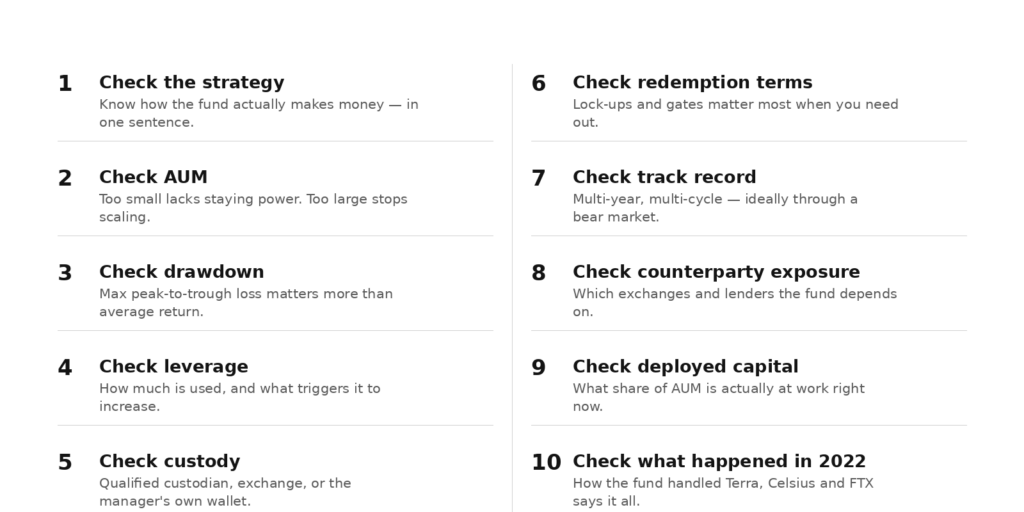
1. Check the strategy
Understand clearly how the fund generates profits – market-neutral, directional, yield farming, or arbitrage. If you cannot put it in one sentence, the managers cannot either.
2. Check AUM
Being small-sized implies insufficient resources for operations, whereas being large-sized implies too many to implement the strategy.
3. Check drawdown
The maximum drawdown and the average return rate have to be considered in this case. A fund that generated a 40% return on investment with a 60% drawdown during this period can show a lot about your risk tolerance.
4. Check leverage
Inquire about the level of leverage and when it grows, and under what circumstances. Leverage is what makes your manageable drawdown turn into a fatal one for the fund.
5. Check custody
Who will hold the money? Is it the custodian, the exchange, or the manager’s pockets? Self-custody in favor of the manager is the weakest link.
6. Check redemption terms
The most important conditions are lock-up periods, gate provisions, and notice requirements, and you’ll want to know that when you’re trying to redeem.
7. Check track record
It is important to have a multi-year, multi-cycle track record, preferably with at least one bear market. A good 2023-2024 track record doesn’t necessarily prove anything.
8. Check counterparty exposure
Are there any exchanges, lenders, and prime brokers that are exposed to the fund? Overexposure to one counterparty was what almost all 2022 blow-ups had in common.
9. Check whether AUM is deployed
Is it possible that the fund may be sitting in a lot of cash or stables when promoting an active investment strategy? Find out how much capital is currently being utilized.
10. Check what happened during 2022
The single best filter. How the fund handled Terra, Celsius, and FTX tells you more about risk management than any pitch deck ever will.
Conclusion
All crypto funds are certainly not playing by the same rules. While some seek out high returns, some others are more focused on trade, while there are some that do not mind waiting for years before seeing any profits from their investments. It is the approach to handling risks that distinguishes them.