

Crypto bridges let you move assets between blockchains, but not every bridge offers the same speed, security, or reliability. Here’s a closer look at the best crypto bridges and where each one performs best.
Choosing “the best”
A single bridge cannot be considered “the best” on all counts, so “best” will be determined separately by each criterion:
- Survives – audit history and exploit record over marketing claims.
- Lands fast – in seconds, minutes, or days, and what it really costs to go that fast.
- Costs what it says – fee plus slippage plus the gap between quoted and received.
- Goes where you need it – chain coverage, especially outside the EVM.
A recent Reddit discussion about moving around $1,000 in USDC to Solana illustrates how much the final cost can vary. The user tracked transfers over two weeks and found quotes ranging from under $5 to slightly above $10, with the time of day affecting the result almost as much as the bridge itself.
One commenter explained why comparing headline fees can be misleading: “Most bridges quote you a route, not a fee. What you’re seeing as ‘bridge cost’ is usually source-chain gas plus the spread”
The distinction matters throughout this comparison. The fee shown by a bridge is only part of the equation; gas, liquidity, routing and network conditions can all change the amount that actually arrives on the destination chain.
Ways a bridge can hold your money
Skip this if you already know lock-and-mint from intent-based routing. If not, it explains almost every hack in this article.
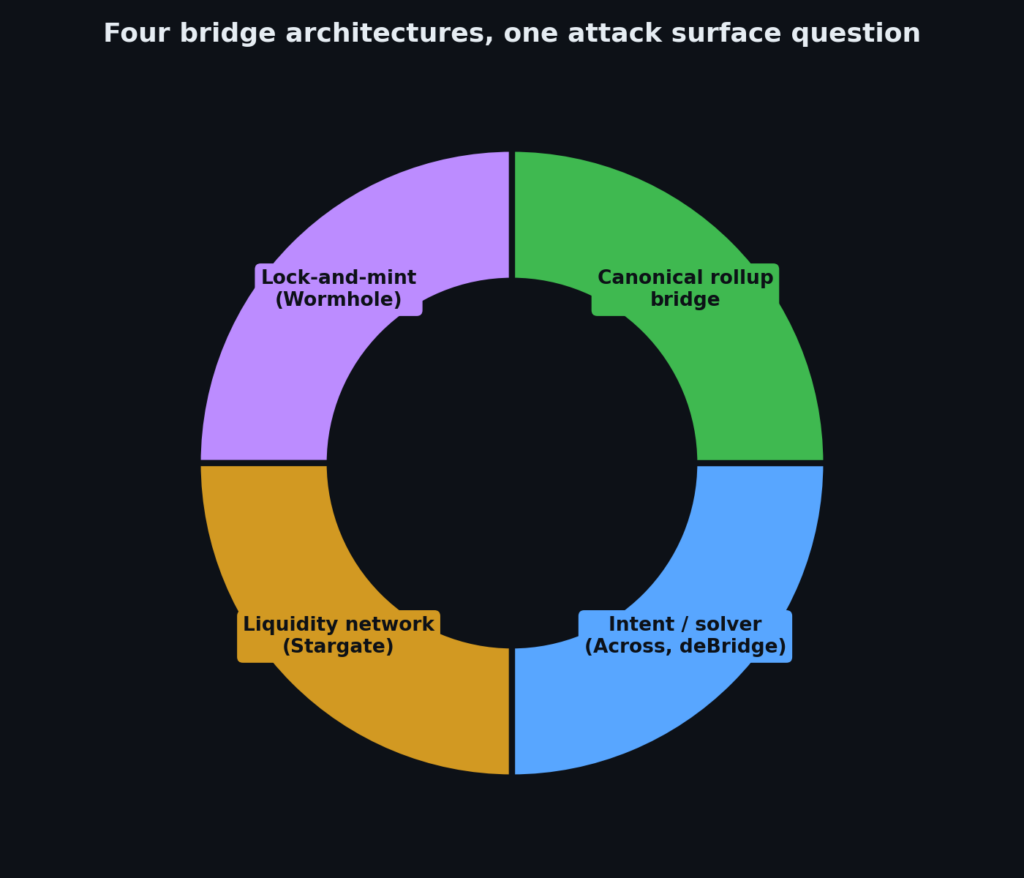
- Lock-and-mint – your token gets locked, a synthetic copy gets minted elsewhere. Wide reach, but that synthetic copy is only worth what’s backing it.
- Liquidity pools – the bridge pays you out of a local stash on the other side. No synthetic asset, but big transfers against a thin pool mean slippage.
- Intent/solver – you say what you want, solvers front the cash and settle later. Little to no locked liquidity sitting around as a target.
Best crypto bridge platforms: The top 11
1. Across Protocol

Across is a protocol that primarily aims at fast token transfers from Ethereum to its Layer 2 networks. With its intent-based system, users can easily send and receive native tokens without wrapping.
Intent-based bridging is also becoming a broader infrastructure approach rather than a feature of a single bridge. Across has been involved in the Open Intents Framework, which aims to establish common standards for intent-based execution.
"With the Open Intents Framework, we’re taking a major step toward that reality – establishing shared standards for intent-based execution.” – Hart Lambur (@hal2001)
— Across (@AcrossProtocol) February 19, 2025
Read the full article on the Open Intents Framework below ↓ https://t.co/eEeNTB4KSC
Pros:
- Easy-to-use system
- Good fit for Ethereum L2 transfers
- Good capital efficiency
- Native assets on supported routes
- Well suited for frequent transfers
Cons:
- Limited usefulness outside EVM networks
- Some assets have weaker route availability
- USDT support is less consistent than USDC
Verdict: clear winner as the best bridge for transferring USDC and ETH across Ethereum Layer 2, way ahead of the rest of the bridges in this list.
Model: intent relay network with bonded relayers and an optimistic oracle by UMA
Speed: 2-15 seconds (Base to Arbitrum) for a $500 fee; that is, around $0.30
Native output: yes
Track record: in use since 2021; relayers have not failed yet
Watch out for: bad USDT liquidity, lack of accessibility outside of EVM
2. deBridge

deBridge operates on the premise of cross-chain swaps without holding large liquidity reserves. The project is useful when you want to make large Solana swaps or cross-chain swaps.
Solana transfers can show noticeable differences across bridge routes, even when the asset and amount are the same. In a recent Reddit discussion, a user comparing a $10,000 USDC transfer from Solana to Ethereum reported a $220 difference between the best and worst bridge quote.
Pros:
- Perfect for large-scale transfers
- Perfect Solana support
- Effective capital structure
- Transfers of native tokens
- No large liquidity pools controlled by the protocol
Cons:
- Requires access to solvers
- Supports fewer assets compared to other bridges
- Less suitable for users looking for the widest possible chain coverage
Verdict: perfect option for large transfers or for situations where there’s Solana involved.
Model: intent/solver connection, effectively 0-TVL (no liquidity in the pool that the protocol manages)
Speed: ~18 seconds
Fee: fixed fee of around $0.50 + solver spread of around 4bps (fee: $0.55-$0.86 based on the amount)
Native output: yes
Track record: $60 billion+ overall volume, no exploits ever reported
Watch out for: the health of the solver network itself, not the pool
3. Circle CCTP
Circle CCTP is designed specifically for moving USDC between supported blockchains. Instead of creating a wrapped version, it burns USDC on the source network and mints native USDC on the destination.
CCTP is also being integrated directly into new networks. In February 2026, Morph announced that USDC and CCTP were coming to the network:
USDC and CCTP are coming to Morph!
— Morph (@MorphNetwork) February 26, 2026
A new foundation for dollar settlement on Morph. @USDC and CCTP for secure cross-chain transfers are coming to infrastructure designed for real payment flows.
Stable dollar settlement. Built for scale.
Learn more ↓ pic.twitter.com/CZqdHTiUEa
It is a good example of where CCTP fits: native USDC settlement between supported networks rather than a general-purpose bridge for many different assets.
Pros:
- Both USDC natively on either side
- Best suited for larger transactions
- Low-cost transactions
- No wrapped USDC exposure
- Built upon Circle’s technology
Cons:
- Limited primarily to USDC
- Only works across supported networks
- Older integrations may still use the slower V1 system
Verdict: best option for six-figure transfers to/from USDC – and mid-upgrade currently, so please see below before citing it as “13- 19 minutes”.
Model: Burn and mint, no wrapped asset, unique attestation from Circle
Speed: V1 (legacy) 13–19 min · V2
Fast Transfer: 8 – 20 seconds
Fee: very low flat fee that doesn’t depend on the size of the transaction, $0.25 – $0.50
Native output: yes, real USDC on both sides
Track record: V1 deprecation process officially underway since July 31, 2026 – this week
Watch out for: legacy integrations citing V1 times
4. Stargate v2

Stargate v2 relies on LayerZero technology and liquidity pools for interoperability between different networks. In that sense, it still makes sense to use it for tokens or chains that are poorly supported by other purpose-built bridges.
Pros:
- Support of numerous networks
- Useful for USDT transfers
- Native asset support on many routes
- Established cross-chain infrastructure
- Good alternative when other bridges do not support a route
Cons:
- Pool liquidity may impact execution
- Larger transactions may experience more slippage
- It can be more expensive compared to intent-based systems
- Quality of routes depends on the asset/network pair
Why do users still choose expensive bridges?
A Reddit discussion comparing Stargate and Orbiter raised a simple question: why pay significantly more Ethereum gas when another service can execute the transfer with a much lower gas requirement?
One user compared roughly 450,000 gas for Stargate with around 21,000 for Orbiter for ETH bridging.
The discussion points to the broader trade-off behind bridge usage: users are not necessarily optimizing for gas alone. Liquidity, supported routes, security assumptions and existing network effects can all influence which bridge gets used.
Verdict: the option to go with when neither Across nor CCTP covers the asset or the network – mostly USDT.
Model: pools per chain based on LayerZero technology
Speed: minutes (batching)
Fee: ~$1.10 on $500
Native output: yes
Watch out for: slippage due to the shallowness of the local pool (check DeFiLlama first)
5. Wormhole

Wormhole is a broad cross-chain protocol that connects EVM networks with ecosystems such as Solana, Aptos, and Cosmos. Its main strength is reach, not the lowest transfer cost.
Pros:
- Very broad chain coverage
- Supports several non-EVM ecosystems
- Mature cross-chain infrastructure
- Useful for unusual or less common routes
- Strong ecosystem integrations
Cons:
- Wrapped assets on many routes
- Higher transfer costs
- Security history includes a major past exploit
- Users need to check the exact token received
Verdict: broadest coverage chain of the ones presented below; however, it is accompanied by the drawback of wrapped tokens.
Model: lock and mint, Guardian validators
Coverage: EVM, Solana, Aptos, Cosmos, Bitcoin networks
Speed: minutes
Fee: highest cost among all; costs $4.50 to send $500
Track record: lost $320 million in February 2022 because of a fake signature, but has now improved its security
Watch out for: you have a synthetic asset, not the real one
6. Relay
Relay is an easy-to-use platform built on a simple user experience, not complicated bridge technology. It lets you use intent-based routing that makes cross-chain transactions feel like ordinary swaps.
Relay is also being added to other cross-chain routing stacks. In April 2026, Enso announced support for Relay:
Enso now supports Relay for cross-chain routing.@RelayProtocol complements our existing bridge stack and increases flexibility when building cross-chain flows.
— Enso | ⌘ 🛠️ (@EnsoBuild) April 8, 2026
This directly improves execution quality; more paths simulated lead to more precise routing and outcomes that align… pic.twitter.com/6qT7yH4VjG
The more routes a routing layer can access, the more options it has when deciding how a transfer should be executed.
Pros:
- Easy-to-use interface
- Fast transfers
- Low-cost transfers in popular corridors
- No need to open an account/KYC
- Automated destination gas fee
Cons:
- Consumer-focused mostly
- Dependent on available routes through networks
- Solvers only work one at a time
- Not ideal for corporate transactions
Verdict: highly recommended for quick and easy customer payments.
Model: intent-based, consumer-centric
Speed: seconds
Fee: most affordable, about $0.25 per $500
Access: no account, no KYC, auto gas on destination
Watch out for: not meant for institutions; depends on specific solver used
7. Axelar
Axelar is more of a generic cross-chain message-passing system than an asset-transfer system. For this reason, Axelar can link networks that other specific bridges cannot
Pros:
- Large network ecosystem
- Supports cross-chain applications beyond transfers
- Useful for less common blockchain connections
- Integrated with multiple cross-chain applications
- Flexible messaging infrastructure
Cons:
- Wrapping representations for some paths
- Different fees for different networks
- Harder compared to a basic bridge
- Users should make sure about the final asset
Verdict: best choice when Stargate doesn’t support a certain blockchain for USDT transfer.
Model: general messaging + Interchain Token Service with Squid relays
Coverage: 40+ chainsFee: ~$0.90 on $500
Speed: ~1 minute
Watch out for: if the Axelar messaging is the only available path, the output will be axlUSDT instead of native USDT
8. Hyperlane
Hyperlane uses a permissionless model of interchain communication, where any new route can be established without being tied to a single central bridge operator. This is especially intriguing for new blockchain networks.
Pros:
- Permissionless architecture
- Good support for newer networks
- Flexible cross-chain messaging
- Developers are able to create their own routes
- Useful in which traditional bridges have limited coverage
Cons:
- Route quality can vary
- Users need to check individual operators
- Security depends on the configuration of each route
- Less predictable for inexperienced users
Verdict: ideal for chains too young for others to have made a bridge between them.
Model: permissionless message passing; anyone can run a bridge route
Coverage: 27+ chains including newer chains (Swellchain, Plume, Sei)
Rank: #1 in TVL by DeFiLlama
Fee: variable, route-dependent
Watch out for: permissionless means quality of routes is uneven – verify operators of your specific route
9. Synapse
Synapse is an ongoing cross-chain protocol that utilizes bridging and swapping using liquidity pools. The protocol works well for known routes but is not as suitable for transferring large sums through shallower pools.
Pros:
- Long operating experience
- Can be used on several blockchain platforms
- Swaps and bridging in one protocol
- Good for existing paths
- Known protocol for DeFi users
Cons:
- Pool depth can limit larger transfers
- Slippage becomes more important at higher volumes
- Usually slower than the fastest intent-based bridges
- Not always the cheapest route
Verdict: veteran – knows all about the trodden paths; no good for mass trading.
Model: intermediary nUSD pool, swap in / swing bridge swap out
Fee: ~$1.30 on $500
Speed: several minutes
Watch out for: slippage in larger trades > ~$1M into the nUSD pool
10. LI.FI
LI.FI is not a bridge itself, but an infrastructure and routing layer that routes through various bridges and decentralized exchanges – its main purpose is to help users who prefer automatic route comparison instead of picking a bridge themselves.
For users, the difference between choosing a bridge and choosing an outcome can be significant. A recent Reddit deep dive into LI.FI Intents described the traditional process as specifying each step of a cross-chain transfer, while intents focus on the result the user wants.
“Intents replace steps with outcomes.”
Pros:
- Availability of multiple bridges to use
- Automatic route selection
- Can combine swaps and bridges
- Useful for applications and wallets
- Reduces the need to compare protocols manually
Cons:
- Final route depends on third-party bridges
- Users inherit the risks of the selected route
- Execution can vary depending on market conditions
- Less control for users who want to select the bridge themselves
Verdict: best if you’d rather not choose at all.
What it is: not a bridge – an orchestrator on top of all nine above
Model: routes each transfer through whichever rail is cheapest/fastest at that moment
Best for: anyone who doesn’t want to track nine protocols individually
11. Jumper

Jumper offers a good way to trade tokens across chains through many underlying bridges and liquidity sources. The solution is especially useful when the result matters more to the user than the protocol itself.
Pros:
- Easy-to-use interface
- Wide chain coverage
- Combines swapping and bridging
- Multiple routes available
- Useful for users who do not want to compare bridges manually
Cons:
- Underlying bridge is not always obvious
- Safety is dependent on the chosen path
- Execution may differ between services
- Always be sure to verify the funds received before approving
Verdict: basically LI.FI but with a nicer interface and rewards.
Model: aggregator; does swap → bridge → swap, picks the best route
Coverage: 55+ chains
Speed: 10-30 sec for most EVM routes (Across & CCTP V2)
Fee: no additional fees according to the official claim, but some sources are saying that the 0.3% fee is embedded – be sure to verify the total before confirming
Watch out for: you inherit the risk of whatever bridge it ends up routing you through
The Hidden Cost of a “Cheap” Bridge
| Advertised cost | What you may actually pay |
|---|---|
| Bridge fee | Protocol fee |
| Gas | Source + destination gas |
| Slippage | Thin liquidity pools |
| Price movement | Asset value changes during transfer |
| Wrapped asset discount | Lower liquidity after bridging |
A bridge with a $0.30 fee can still cost several dollars once slippage and execution are included.
What $500 actually costs, measured – not quoted
| Bridge | Model | $500 fee | Finality | Native output |
|---|---|---|---|---|
| Relay | Intent | ~$0.25 | Seconds | Yes |
| Across | Intent | ~$0.30 | 2–15 sec | Yes |
| CCTP (V2 Fast) | Burn-and-mint | ~$0.35 | 8–20 sec | Yes |
| deBridge | Intent, 0-TVL | ~$0.55 | ~18 sec | Yes |
| Axelar | Message passing | ~$0.90 | ~1 min | Mostly (native, some axl-wrapped) |
| Stargate v2 | Liquidity pool | ~$1.10 | Minutes | Yes |
| Synapse | Pool + swap | ~$1.30 | Minutes | Yes |
| Wormhole | Lock-and-mint | ~$4.50 | Minutes | Wrapped |
Fees become less important when the amount being transferred is large enough for a failed or difficult-to-reverse transaction to matter more than a few dollars saved.
Reddit user: “Sometimes a boring bridge with deep liquidity and a clear failure path is better than a clever route you cannot unwind.”
That risk is difficult to capture in a simple fee comparison. It depends on the bridge architecture, liquidity, verification mechanism and what happens when part of the route fails.
Why “survives” outranks “cheap” in this ranking
This is the part that actually decides who’s “best” above – not the fee column. It’s the same script almost every time a bridge gets drained, which is the part that should worry you more than any single dollar figure:
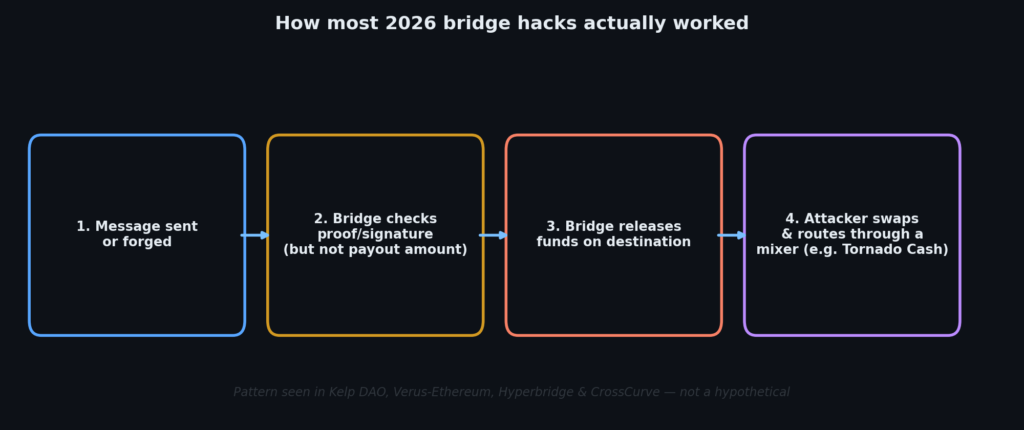
April 2026 saw the most DeFi hack attempts ever seen – 30 attacks in total, nearly one every day. Eight bridges saw losses exceed at least $328.6M from exploits between February and May 15. Here is the breakdown by incident, without any rounding:
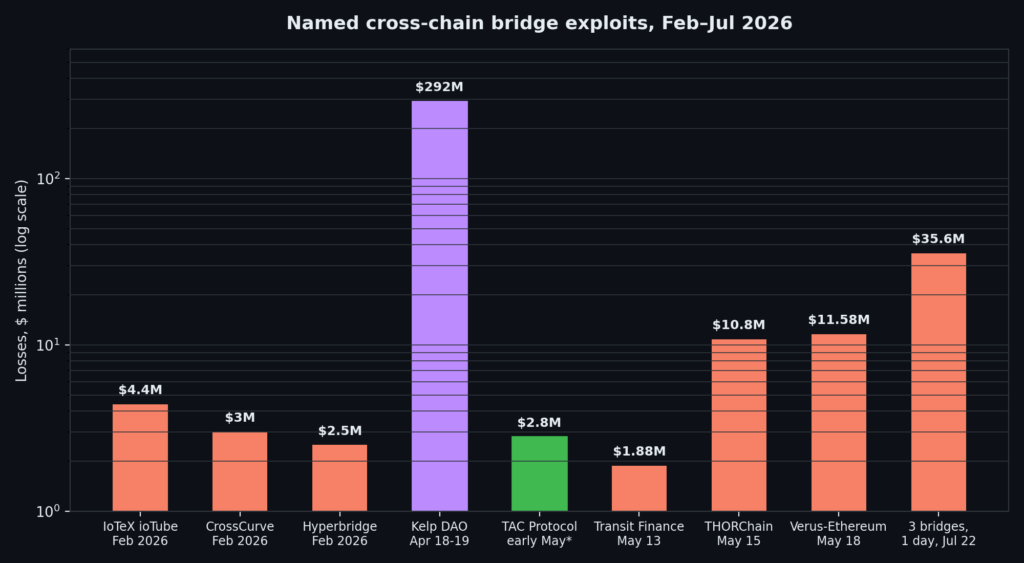
The biggest hack: Kelp DAO, April 18–19, $292M – hackers spoofed a cross-chain message in the LayerZero-powered bridge adapter, earning 116,500 rsETH, which was 18% of the entire token supply. No exploit in the smart contract code – the bridge just trusted a message it shouldn’t have. The hackers were identified as Lazarus Group; LayerZero blamed Kelp’s configuration (a supposedly single Decentralized Verifier Network); and Kelp contested that characterization.
There were even some good things to come out of 2026 attacks; the $2.8M hack on TAC Protocol in early May was later classified as a “white hat” hack because the “attacker” took a 10% bounty while returning the rest.
An exploit can also create a second problem: moving the stolen funds across networks. In its analysis of the April 2026 Drift exploit, Range tracked the movement of the stolen assets through several interoperability protocols:
“Within hours, the bulk of the ~$285 million was bridged to Ethereum through Circle’s CCTP, Wormhole and deBridge in parallel.”
The bridges were not the source of the Drift exploit. They were among the routes used to move the funds afterwards, which is a separate part of the security picture.
None of this means don’t bridge. It means the best bridges are the ones giving an attacker the least to trust in the first place – which is exactly why TVL and intent-based designs (Across, deBridge) sit at #1 and #2 above, and why a broad-reach, lock-and-mint bridge like Wormhole ranks lower despite covering more chains than anything else on this list.
What Happens After You Click “Bridge”?
Wallet
↓
Bridge
↓
Validation
↓
Settlement
↓
Destination
Which is the best crypto bridge for your specific transfer
- Quick stablecoin hop between L2s (under $5,000): Across or Relay.
- Large institutional USDC move ($50,000+): Circle CCTP – cost barely scales with size, and V2 closes most of the old speed gap too.
- Moving in or out of Solana: deBridge.
- USDT, or a chain CCTP hasn’t reached: Stargate or Axelar/Squid.
- Maximum chain reach, including exotic ecosystems: Wormhole, wrapped-asset trade-off included.
- Real BTC, no wrapping, no bridge in the classic sense: THORChain – with eyes open about its own May 2026 incident.
- Don’t want to think about any of this: an aggregator (LI.FI, Rango) routes it for you.
Red Flags Before Bridging Large Amounts
- The bridge hasn’t published recent security reviews.
- The route ends with a wrapped token instead of a native asset.
- Liquidity is unusually low for the asset you’re transferring.
- The quoted amount changes significantly before confirmation.
- The bridge relies on a small validator or relayer set.
If you have WETH on Aave V3 Core, withdraw now, ask questions later.
— Marc Zeller (@mzeller) April 18, 2026
One more, less obvious flag: watch what happens in the first hour after a bridge you use gets hit, not just whether it ever gets hit. Aave’s Marc Zeller telling depositors to withdraw “now, ask questions later” – before Kelp DAO itself had even confirmed the exploit – is what a healthy, fast-reacting DeFi ecosystem actually looks like in practice. A protocol whose integrators go quiet instead is a worse sign than the hack itself.
Bottom line
While many crypto bridges are available today, the best bridges of 2026 will not be the ones with the largest logos or the noisiest TVL figures. Instead, they will be Across and deBridge for standard and Solana bridge use, respectively, Circle CCTP for sheer scale, and LI.FI aggregator for when you’d rather have someone else choose for you. Wormhole and Stargate will keep their places based on reach and USDT bridge support, but they both require compromises the first two bridges don’t.