
Crypto insurance is becoming an increasingly important part of the digital-asset industry, covering risks such as custody theft, cyber incidents, and smart-contract failures. But coverage stays highly specific, with major differences between policies and providers.
This brief examines who offers crypto insurance, what it covers, and where coverage still falls short.
Three types of crypto insurance
- Custodial – covers theft or a breach at the company holding your assets. The business buys it, not you personally.
- DeFi/smart contract – protects against an exploit of a particular protocol (Aave, Curve, Uniswap).
- Personal/retail – covers your own hot wallet against phishing, device compromise, or lost keys.
- Confusing these three is the main reason people discover “exclusions” only after the money is gone.
What insurers check first
Before offering crypto coverage, insurers look at a few basic things:
- Where the assets are stored – hot wallet, cold storage, or both
- Who controls the private keys
- How transactions are approved
- What security controls are in place
- How the company responds to a security incident
- Whether the technology or protocol can change after the policy is issued
Lloyd’s specifically identifies private-key security, hot and cold storage, code changes, cyber risk, and technology breakdowns as important underwriting considerations for cryptoassets.
Facts worth knowing
- The crypto insurance market is set to grow from $9.5B in 2025 to $192.7B by 2033 – a 45.8% CAGR (per Grand View Research)
- Evertas is the only cryptoasset insurer selected by Lloyd’s of London as a listed coverholder in its official marketplace
- Nexus Mutual claims are open for voting for at least 72 hours, and at least 2 of 3 Claims Committee Assessors need to accept a claim
- Coincover completed a SOC 2 Type II audit in 2025
- Aon says its crypto insurance track record began with the first “crypto crime” policies in 2013
The track record: hacks vs. what insurance actually paid
Insurance sounds good when one sees how much it will cover. However, the funds exchanges hold usually suffice to cover any major breach, including company assets, returned funds, funding, or even insurance pools.
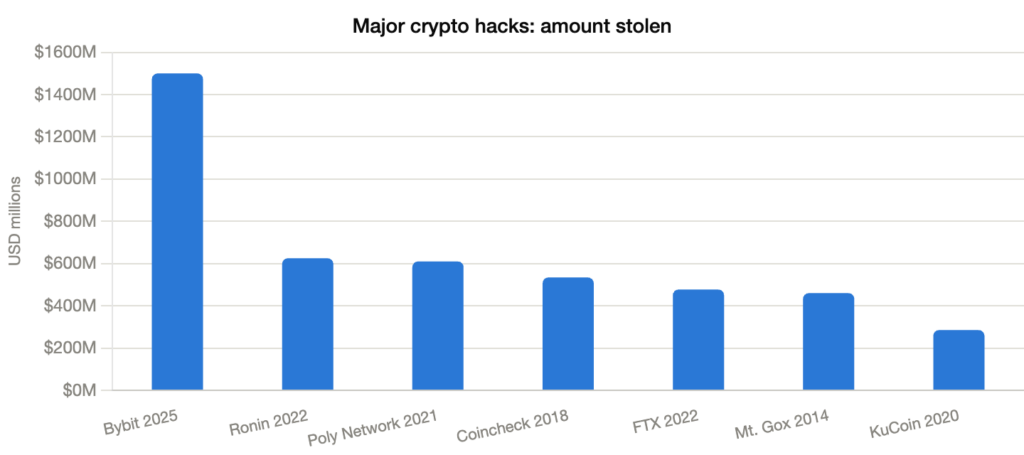
- Bybit (2025) – $1.5B loss. The FBI identified the attack as being carried out by North Korean actors
- Ronin Network (2022) – $625M loss; the victims were reimbursed by Sky Mavis and raised $150M through Binance
- Poly Network (2021) – $610M lost; the thief recovered the stolen money
- Coincheck (2018) – $534M lost; the company promised compensation to the victims
- FTX (2022) – approximately $477M was estimated by Elliptic to have been stolen during the bankruptcy filing period
- Mt. Gox (2014) – approximately $460M in Bitcoin was stolen, followed by a long-running bankruptcy and creditor recovery process
- KuCoin (2020) – approximately $285M stolen. KuCoin recovered $222M (78%) through industry cooperation and $17.45M (6%) through law enforcement, while KuCoin and its insurance fund covered the remaining $45.55M (16%)
Myths vs. Reality
- Myth: “Because I am insured through my exchange, my money is insured.” Reality: Insurance through your exchange protects you against any breaches of security regarding the reserves of your exchange, not losses that you may incur through phishing or withdrawal without authorization.
- Myth: “The insurance of DeFi covers hacks.” Reality: Nexus Mutual insurance and other DeFi insurance do not cover all hacks; they cover only the risks listed in the policy.
- Myth: “If I get an insurance policy, my loss will be compensated.” Reality: Each insurance policy has an exclusion list, and all depend on its terms.
- Myth: “A large-scale hack means compensation for the amount of the hack.” Reality: The scale of the breach does not automatically mean the amount of insurance payments.
Best providers by category
Choosing the right provider will depend on your actual needs. Different insurance providers specialize in different kinds of protection like institutional custody, Bitcoin custody, DeFi threats, or even custom insurance designed for crypto companies. Let’s take a look at the available options.
Best for institutional custody – Evertas

Evertas focuses on insurance for businesses that hold or manage digital assets, including custodians, exchanges, funds, and other institutional crypto companies. Its policies have been designed around risks such as theft, crime, cyber incidents, and operational failures, making them better suited to organizations with significant assets than to individual users.
- Coverage up to $360M per policy
- Backed by Arch, a Lloyd’s syndicate member
- Evertas describes itself as a specialist cryptoasset insurer.
- Best for: custodians, exchanges, investment funds, family offices, mining operations
- Founded in 2018 in Chicago, formerly known as BlockRe
Pros:
- High coverage limits
- Designed specifically for digital-asset businesses
- Suitable for large institutional holdings
- Access to Lloyd’s insurance capacity
- Can be structured around the client’s custody setup
Cons:
- Mainly aimed at institutional clients
- Not designed as a simple retail wallet policy
- Coverage depends heavily on the security controls of the insured business
- Bespoke policies can be more complex to arrange
Best for a retail hot wallet – Coincover

Coincover focuses on protecting digital-asset users through wallet security, recovery, and insurance-backed protection. Rather than functioning like a traditional insurer that sells a broad personal crypto policy, it integrates protection into supported wallet and digital-asset services.
- Provides wallet protection and recovery solutions
- Its protection technology is insured
- Coincover completed a SOC 2 Type II audit
- Best for: wallet providers and supported customers
- Based in Cardiff, Wales, founded in 2018
Pros:
- User-friendliness for crypto owners
- Focused on securing wallets
- Insurance coverage
- Recovery methods can be used in conjunction with insurance
- SOC 2 Type II audited
Cons:
- Availability depends on the supported wallet or service
- Not every type of crypto loss is covered
- Coverage limits and conditions vary
- Users still need to examine the specific protection terms
Best for DeFi risk – Nexus Mutual

Nexus Mutual takes a different approach from traditional insurance companies by operating as an on-chain mutual. Members collectively provide capital for coverage, while its governance-based claims process reviews claims. It is especially helpful for users who want protection against defined risks within specific DeFi protocols.
- On-chain mutual insurance: risk is shared by pool members, not a centralized insurer
- Transparent on-chain pricing and claims review
- Coverage depends on the specific Cover Product and its terms
- Founded 2017
Pros:
- Created considering the risks associated with DeFi
- On-chain transparency
- Focuses on protocol-specific risks
- Claims determination through community review
- Useful to active DeFi participants
Cons:
- Universal coverage is not available among all DeFi projects
- Policies have specific exclusions
- Claims depend on the applicable Cover Product and assessment process
- Not suitable for general wallet theft or every type of crypto loss
Best for regulated BTC custody in the US – AnchorWatch

AnchorWatch combines Bitcoin custody infrastructure with insurance options for clients using its custody model. Its Trident Vault system is built for institutional-grade Bitcoin custody, and clients can add insurance to eligible custody arrangements.
- Insurance on Bitcoins with backing from Lloyd’s of London
- Assets are held through its Trident Vault custody system
- Insurance can be added to AnchorWatch custody models
- Best for: Bitcoin holders and institutions using its custody infrastructure
Pros:
- It concentrates on Bitcoin only
- Insurance with backing from Lloyd’s
- Integration of custody and insurance
- Suitable for larger Bitcoin holders
- Built on a controlled custody platform
Cons:
- Concentrates on Bitcoin only
- The insurance system is linked with its custodial model
- Less suitable for users holding a broad range of tokens
- Availability and coverage depend on the specific arrangement
Best for complex exchange and protocol risk – Relm Insurance

Relm Insurance serves digital-asset and Web3 companies that need more customized coverage than standard insurance products provide. Its solutions can be organized around several types of crypto-related exposure, including cyber, crime, smart-contract, and staking risks.
- Custom insurance solutions tailor-made for Web3 firms
- Insurance protection for cyber, crime, smart contract, and staking exposure
- Best for: firms that do not fit the traditional mold
Pros:
- Flexibility in designing insurance structures
- Appropriate for complex crypto businesses
- Can address multiple types of digital-asset risk
- Useful for exchanges and protocols
- Better suited to unusual risk profiles
Cons:
- More relevant to businesses than individuals
- Custom policies can be harder to compare
- Pricing depends on the risk profile
- Coverage requires detailed underwriting
Best brokerage access to the largest limits – Marsh and Aon

Marsh and Aon are insurance brokers, not crypto insurers themselves. Their main advantage is access to a broad insurance market, allowing large crypto companies and institutions to build customized placements when a standard policy is not sufficient.
- Not insurers themselves – brokers with access to insurance markets
- Can arrange bespoke insurance placements for institutional clients
- Best for: large custodians and funds that need a tailored placement, not a packaged product
Pros:
- Access to multiple insurance markets
- Suitable for large institutional clients
- Can arrange bespoke coverage
- Useful for high-value custody and exchange risks
- Can combine different types of insurance
Cons:
- Are not insurance companies directly
- Mainly focused on institutional clients
- Bespoke placements can take longer to arrange
- Policies may be more complicated than standard products
- Not as practical for individual crypto holders
Comparison table
| Provider | Coverage Type | Best For | Max Limit |
|---|---|---|---|
| Evertas | Custodial | Custodians, exchanges, funds | up to $360M |
| Coincover | Retail | Individual holders | quoted per application |
| Nexus Mutual | DeFi | Protocol users | pool-dependent |
| AnchorWatch | BTC custody (US) | Individual US investors | on request |
| Relm Insurance | Custom packages | Exchanges, protocols | on request |
| Marsh/Aon | Brokerage | Institutional clients | highest in market |
What’s usually NOT covered
- Lost private keys due to your own negligence, depending on the policy
- Phishing attacks on a personal wallet – coverage depends on the specific policy
- Price volatility – insurance doesn’t protect against a market drop
- Losses surpassing the policy’s stated limit
- Voluntarily sending funds to a scammer – coverage depends on the specific policy
How to choose
- Exchange or custodian → Evertas, or a tailor-made insurance placement via Marsh/Aon
- Active DeFi farmer → separate Nexus Mutual cover where an appropriate product is available for each protocol with a substantial amount in it.
- Individual with a supported wallet → Coincover protection solutions can be considered
- EU business under MiCA → find a broker or an insurer that can provide coverage specific to your regulatory case
- Complex risk profile (exchange/protocol) → Relm Insurance for a custom package
- In every case, read the exclusion list before signing, not after an incident
When traditional insurance won’t help either
Many standard insurance policies treat crypto differently from traditional physical property and financial assets. Whether a homeowner’s or other traditional policy covers cryptocurrency depends on the exact wording, exclusions, and applicable limits.
Crypto insurance is still a small part of the insurance world
| Market | 2025 size |
|---|---|
| Crypto insurance | $9.5B |
| Digital insurance | $431.8B |
Crypto insurance was estimated at $9.5B in 2025, while the wider global digital insurance market was valued at $431.8B. That puts crypto insurance at roughly 2.2% of the wider digital insurance market.
The takeaway: crypto insurance is growing rapidly, but it is still a relatively small insurance segment.
Red flags to check before you buy
- A policy that never names its underwriting insurer or insurance capacity – “insured” without a clearly identifiable insurance arrangement is difficult to verify
- Vague wording like “up to $X coverage” with no clarity on per-incident vs. aggregate annual limits
- No mention of whether cold storage, hot storage, or both are covered – ask directly
- An exclusion list that isn’t disclosed until after purchase
- Marketing copy that says “insured” while the actual policy or protection product covers the company or its technology, not the individual account holder
The next evolution of crypto insurance
TODAY
Traditional insurance
↓
SPECIALIST MARKET
Crypto-specific underwriting
↓
NEXT
Cyber + crypto risk combined
↓
FUTURE
Catastrophe-risk products & capital markets
Researchers have already proposed crypto catastrophe bonds that could transfer extreme crypto risks to capital-market investors rather than relying solely on traditional insurers.
FAQ
Does Coinbase or Binance insurance cover my personal account?
Usually, no. Having insurance in place does not mean that it covers a personal account. As far as Coinbase is concerned, their crime insurance policy covers some digital assets against theft due to cybersecurity risks, but not unauthorized access to your personal account.
KEY POINT
Exchange protection ≠ personal account insurance.
Can I insure a cold wallet?
Sometimes. A cold wallet is not insurance per se. Still, some companies may offer certain protection in connection with their custody solution, such as insurance of bitcoins offered by AnchorWatch via its Trident Vault.
KEY POINT
Cold storage reduces risk – it does not automatically insure your coins.
Is DeFi insurance worth it for small positions?
It depends. DeFi cover normally applies to particular protocols and defined risks rather than your entire wallet. Nexus Mutual’s current Single Protocol Cover, for example, covers risks such as smart-contract exploits, oracle failures, liquidation failures, and governance takeovers, while excluding losses such as phishing and private-key breaches. Its default deductible is 5%, although the exact terms can vary.
KEY POINT
Compare the premium with the amount you could actually lose.
Why don’t insurers cover the full amount in major hacks?
Because the amount stolen is not the same as the amount insured, insurance policies have limits, exclusions, and specific conditions. A company can therefore suffer a loss far larger than the insurance capacity it purchased, and some parts of an incident may not qualify for a payout.
KEY POINT
$1B stolen ≠ $1B insured ≠ $1B payout.
Bottom line
In 2026, crypto insurance will be a full-fledged industry, no longer simply an experiment – but a highly one-sided one, where institutional insurance will be more advanced compared to consumer insurance. The wisest thing to do now is not to look for a single umbrella insurance solution but to recognize the individual risks of each element. It won’t cover everything, but it will help you understand the separate risks across custody, protocols, and personal wallets.